
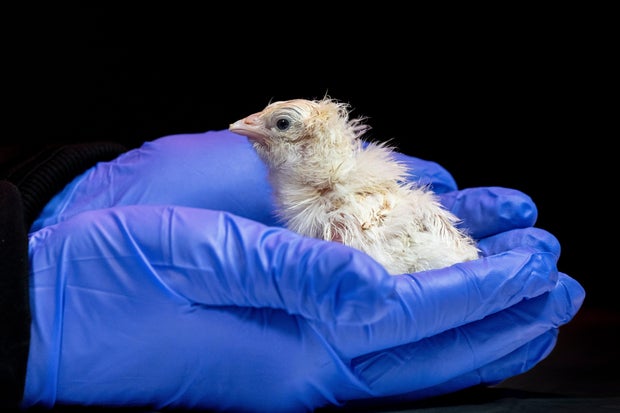
A biotech company has announced the hatching of live chicks in an artificial environment, a move that has sparked mixed reactions from scientists and critics of the company’s de-extinction ambitions. Colossal Biosciences confirmed on Tuesday that twenty-six baby chickens, ranging from a few days to several months old, have been born using a 3D-printed lattice structure that simulates an eggshell.
Colossal Biosciences previously engineered live animals to resemble extinct species, such as mice with hair reminiscent of woolly mammoths and wolf pups resembling dire wolves. CEO Ben Lamm mentioned that their artificial egg technology might eventually allow genetic modifications to produce birds resembling New Zealand’s extinct South Island giant moa. The moa was a massive bird, with eggs 80 times the size of a chicken’s, making it nearly impossible for modern birds to lay. “We aimed to enhance and streamline what nature has achieved,” Lamm added.
The company shared videos and images of scientists handling the hatchlings carefully. Independent experts acknowledge the technology’s impressive aspects but note it’s not fully an artificial egg. Evolutionary biologist Vincent Lynch stated that while the technology might assist in creating genetically modified birds, it won’t lead to an actual revival of extinct species like the moa.
For chick hatching, the company’s scientists poured fertilized eggs into the system and used an incubator. They supplemented calcium, typically absorbed from eggshells, while also capturing real-time development and growth images of the embryos. Colossal designed a membrane filtering appropriate oxygen levels, akin to real eggs, but lacked components like temporary organs that develop to support the growing chick.
Prior research used less sophisticated methods, like transparent eggshells from plastic films, to hatch chicks. These studies facilitate insights into chicken development and can apply to studies of other mammals and humans. “Producing a chick from an artificial vessel is not necessarily new,” explained Nicola Hemmings, a bird reproductive biologist at the University of Sheffield. She isn’t affiliated with Colossal’s project.
Colossal faces a significant journey before attempting a giant moa revival using these artificial eggs. Comparing ancient DNA from preserved moa bones with current bird genomes and developing larger eggshells will be crucial steps. Lamm expressed that they sought to address engineering challenges related to surrogacy and birth immediately rather than awaiting complete readiness to recreate the moa.
Bioethicists like Arthur Caplan from NYU raise concerns about the environments where any resurrected species would live, noting contemporary habitats might not suit them. Some scientists believe resources may be better spent on preserving endangered species rather than attempting to resurrect those long extinct. Hemmings emphasizes her interest in focusing on conservation rather than revival.
Colossal highlighted their technology’s potential beyond de-extinction; it could safeguard declining bird populations. The platform might rescue fragile embryos, facilitate captive breeding, and help revitalize species preserved as frozen cells and DNA.
Initially gaining attention in 2021 with plans to revive the woolly mammoth and later the dodo bird, Colossal announced progress in reviving the extinct Tasmanian tiger in 2024. In a 2023 interview with CBS News, Ben Lamm acknowledged, “When you hear mammoth and dodo, it sounds like science fiction until it’s not.”