
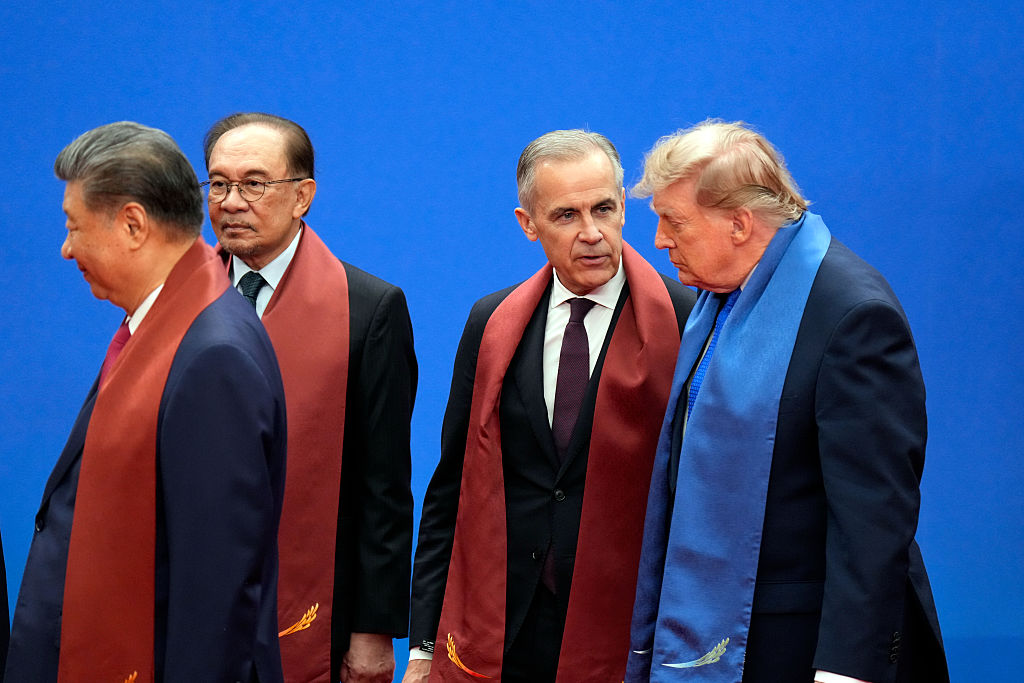
Prime Minister Mark Carney of Canada is prioritizing the improvement of relations with China as he looks to expand international trade and reduce dependency on the United States. This comes during an ongoing trade conflict with the U.S. that has lasted for three months. When questioned about Canada’s strategy in negotiations with Washington, Carney highlighted Canada’s growing relationships globally.
“Our cards are that everyone else in the world wants to deal with us,” Carney stated during a virtual interview with the New York Times from Shenzhen, China. At that time, he was attending the Asia-Pacific Economic Cooperation (APEC) summit with other world leaders. “If the U.S. doesn’t want to do the deal, we’re busy.” His comments followed President Donald Trump’s assertion that the U.S. holds “all the cards” after the breakdown of trade talks in August, which resulted in both nations imposing heavy tariffs in retaliation.
Although Carney had a meeting with Trump during the APEC summit, only a commitment to “continue” talks was achieved without any progress. Carney, however, expressed optimism about his meeting with Chinese President Xi Jinping. Before the summit, Carney and Xi announced a trade agreement between Canada and China that eased tariffs on Canadian agricultural exports and extended certain exemptions for Chinese steel and aluminum imports.
Carney’s “Canada Strong” initiative aims to fortify Canada’s economic stability. He described the new trade pact with China as a step towards “greater certainty and prosperity for all Canadians,” praising China’s straightforward negotiation process.
On an eight-day tour through Europe and Asia, Carney pursued plans to lessen Canada’s economic reliance on the U.S., its largest trading partner. Analysts suggest Canada’s enhanced relationship with China could diminish Trump’s belief in Washington’s leverage in trade talks.
“Canada can afford to be less willing to give the U.S. whatever it asks for because they have other options.”
China, possessing the world’s second-largest economy, presents Canada with significant trade opportunities. Lori Turnbull of Dalhousie University observed that a deal with China might influence U.S. negotiations due to China’s market size and economic rivalry with the U.S.
Carney’s efforts to renew Canada-China ties began with a January meeting with Xi, where both parties established a “new strategic partnership.” This included reducing tariffs on specific Chinese products and securing lower tariffs for Canadian agricultural goods.
President Trump criticized this closer China-Canada relationship, suggesting it could be detrimental to Canada. Experts also warn the relationship might create new challenges.
“Reducing tariffs on select Chinese products might upset Washington.”
Despite tensions, Carney maintained the China-U.S. trade relationship isn’t Trump’s top priority. Still, Canadian officials voice concerns about expanding Chinese automotive presences, as stated by Ontario Premier Doug Ford, emphasizing the protection of Canadian auto workers.
Some criticize the strategic partnership with China, citing national security risks and potential intellectual property theft, as noted by Michael Chong and Canada’s analysis of foreign interference threats.
During an APEC news briefing, Carney confirmed that Canada’s trade with China focuses on commodities rather than sensitive technologies.
Experts highlight that Canada must seek partnerships in sectors where collaboration with China may be less feasible, such as defense and advanced technology.
While in Asia, Carney also completed trade negotiations with the ASEAN bloc and the Philippines, aiming to enhance Canada’s integration with Asian supply chains, although these deals pale in comparison to trade volume with the U.S.
Carney emphasizes that Canada won’t compromise its auto industry in U.S. negotiations, noting China’s advantage in electric vehicle production. He hints at considering Chinese and European carmakers should U.S. talks fail.
Although shifting to Chinese automakers poses logistical challenges, experts suggest the notion may strengthen Canada’s leverage in ongoing U.S. negotiations.