
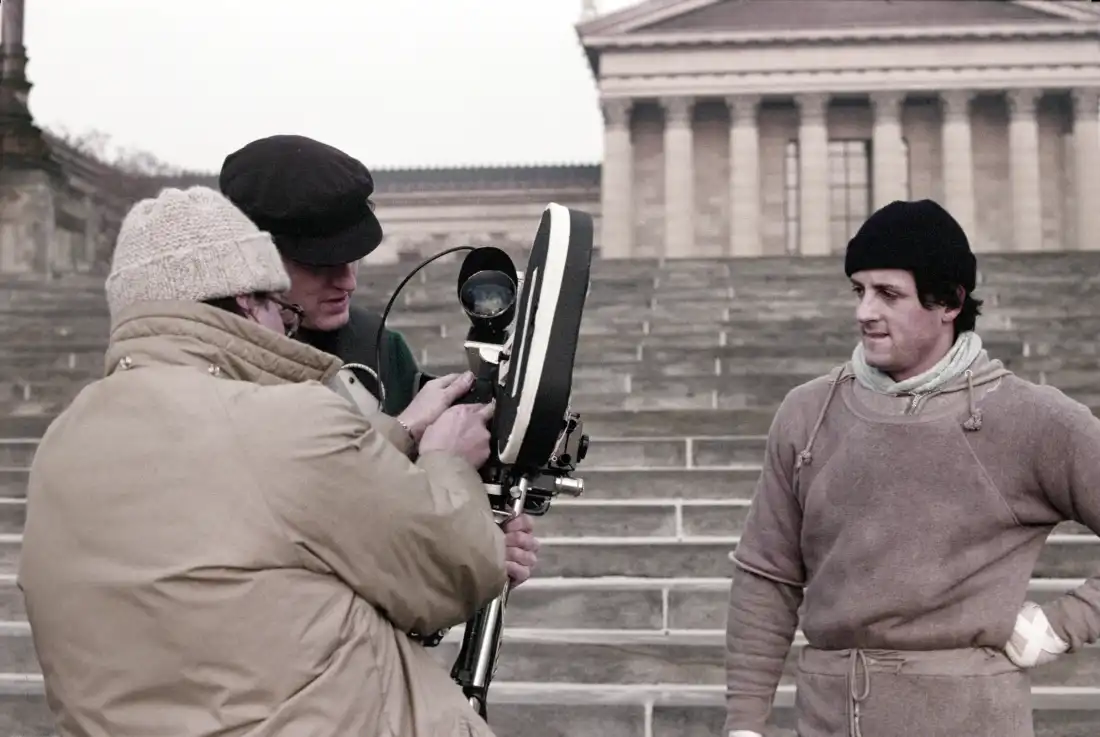
Sylvester Stallone’s iconic film Rocky, which won Best Picture at the 1977 Academy Awards, showcases the ultimate underdog story. One of the most memorable scenes is of Rocky Balboa training for his big match. His routine takes him through trainyards, bustling outdoor markets, and a city jogging path. The training includes speedbag work, push-ups, sit-ups, enduring stomach jabs, and punching frozen sides of beef. This montage culminates with Rocky sprinting up the steps of the Philadelphia Art Museum, celebrating at the top with raised arms.
The new film I Play Rocky tells the story of Stallone’s journey to write and star in Rocky. It also honors Garrett Brown, the original cinematographer, who invented the Steadicam, a tool still widely used. Brown leveraged his invention to film from inside the boxing ring and capture Rocky’s ascent up the museum steps. His work offered audiences a compelling visual experience. Director Peter Farrelly of I Play Rocky highlights Brown’s narrative technique, saying, “He’s not just holding a camera, he’s telling a story.” Through his Steadicam, Brown captured a moment that still resonates with fans decades later.
Brown operated his Steadicam with a harnessed setup, allowing for fluid motion. “It has a harness instead of being in your hands,” Brown explained to NPR. The Steadicam’s design featured a gimbal, minimizing unintentional angular movements, paired with a fiber optic viewfinder strapped to Brown’s head. Brown, reflecting on early trials of his invention, admitted, “You have to be immune to embarrassment to try out inventions like that.” The ingenuity of the Steadicam earned Brown an Oscar in 1978.
Beyond the Steadicam, Brown developed additional innovations like the Skycam for aerial sports coverage, the Mobycam, and Divecam for underwater sports filming. Before these achievements, Brown was a musician. He formed a folk duo, Brown and Dana, with Alfred Dana Arioli. They recorded “It Was a Very Good Year” before Frank Sinatra’s acclaimed rendition. Although the duo found moderate success, a car crash and the rise of The Beatles led Brown to leave music.
Entering filmmaking, Brown initially sold cars and taught himself the craft. He founded a production company, created Sesame Street live-action clips in the 1960s, and invented unique filming tools, like a dog’s eye view dolly. Dissatisfied with traditional shooting equipment, he designed the Steadicam to provide a smooth, realistic perspective, free from the shake of handheld cameras.
Brown recalled spending a focused week in a hotel room in 1974 to draft the Steadicam’s blueprint. With his device, he captured “30 impossible shots” in Philadelphia, captivating filmmakers. One notable sequence had his then-girlfriend Ellen, now his wife, running up the museum steps, echoing Rocky’s famous scene. The footage appears in the new film about Rocky.
In future cinematic ventures, Brown’s Steadicam contributed to groundbreaking visuals. For Return of the Jedi in 1983, he navigated redwood forests, capturing scenes at a pace slower than one frame per second, later sped up for dramatic impact. Stanley Kubrick’s The Shining also benefited from Brown’s expertise. Brown’s contributions continued with films like Indiana Jones and the Temple of Doom.
The Steadicam mirrors human vision’s natural stability, influenced by the inner ear. Brown noted, “In fact, your human eye looks very much like a Steadicam, because when you walk, you don’t even see yourself go up and down. You see a very smooth shot.” Though AI advances, Brown believes the Steadicam requires skilled human operation to achieve its realism.