
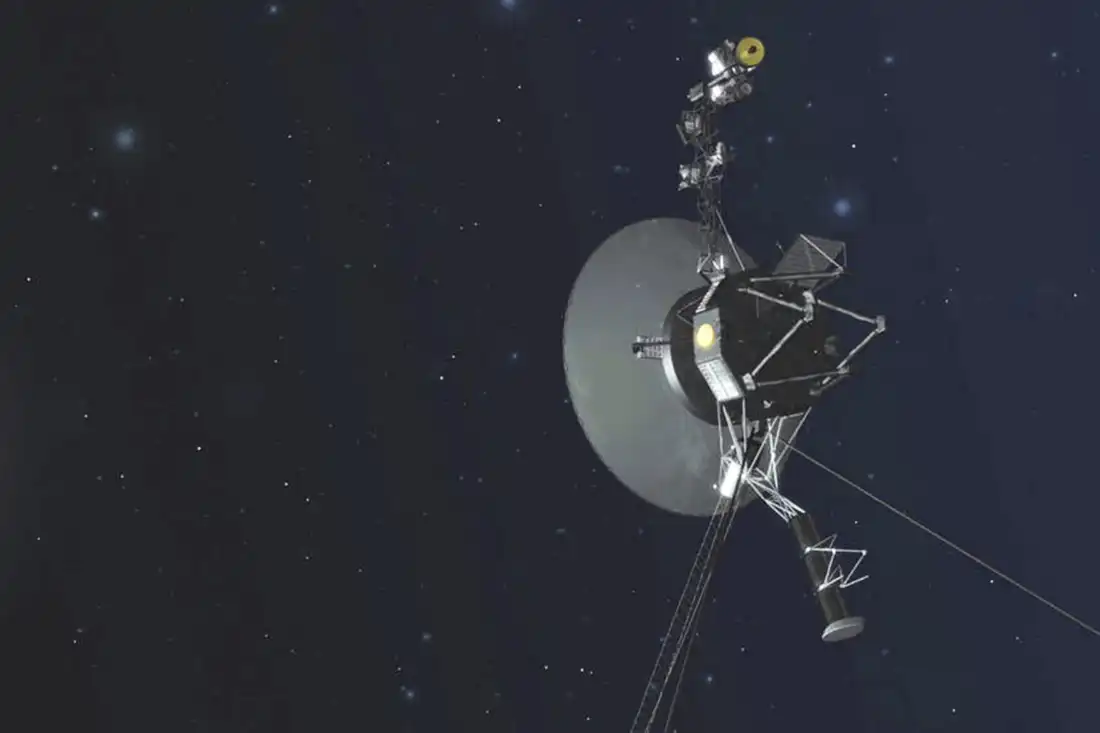
The NASA spacecraft Voyager 1 has surpassed all other human-made objects in space travel distance. On Wednesday, it will achieve a new milestone by reaching a point one light-day away from Earth. To observe this, NASA has launched the ‘Shine Bright for Voyager’s Light-Day’ initiative. The celebration, described as symbolic, encourages the public to transmit Voyager’s call sign, V-G-R, into the sky using Morse code. A flashlight, phone light, or any device capable of blinking a light sequence can be used.
If you wish to participate, the Morse code is:
- V: Three quick flashes, one long flash
- G: Two long flashes, one quick flash
- R: One quick flash, one long flash, one quick flash
What is a Light-Day?
A light-day is the distance light covers in 24 hours, which is over 16 billion miles. Voyager 1 was launched on September 5, 1977, and has been navigating for nearly 50 years. During its mission, it conducted flybys of Jupiter and Saturn, revealing a faint ring system on Jupiter in 1979. It also captured detailed images of Saturn’s rings and moons in 1980.
Voyager 1 became the farthest human-made object from Earth on February 17, 1998, overtaking the U.S. space probe Pioneer 10. Alongside its twin, Voyager 2, it is one of the only spacecraft to have ventured beyond the heliosphere, a protective bubble surrounding our solar system. Voyager 1 reached interstellar space in 2012 and continues to explore magnetic fields, particles, and plasma waves outside the heliosphere and in the vicinity of other stars.
Power Management for Extended Mission Life
Earlier this year, NASA decided to deactivate Voyager 1’s Low-energy Charged Particles experiment to preserve power, hoping to extend its mission lifespan. The spacecraft still operates two scientific instruments: one measuring magnetic fields and another monitoring plasma waves.
The Voyager Golden Record
Voyager 1 carries the Golden Record, an interstellar ‘time capsule’ designed to share Earth’s story with possible extraterrestrial life. This gold-plated record includes 115 images, natural sounds like ocean waves and animal calls, and greetings in 35 languages. It also contains symbolic instructions for playback and information about the probe’s origin.
Voyager 1 is expected to reach ‘light-day status’ at 5:16 a.m. ET on Wednesday after 49 years, two months, and 11 days of journey.