
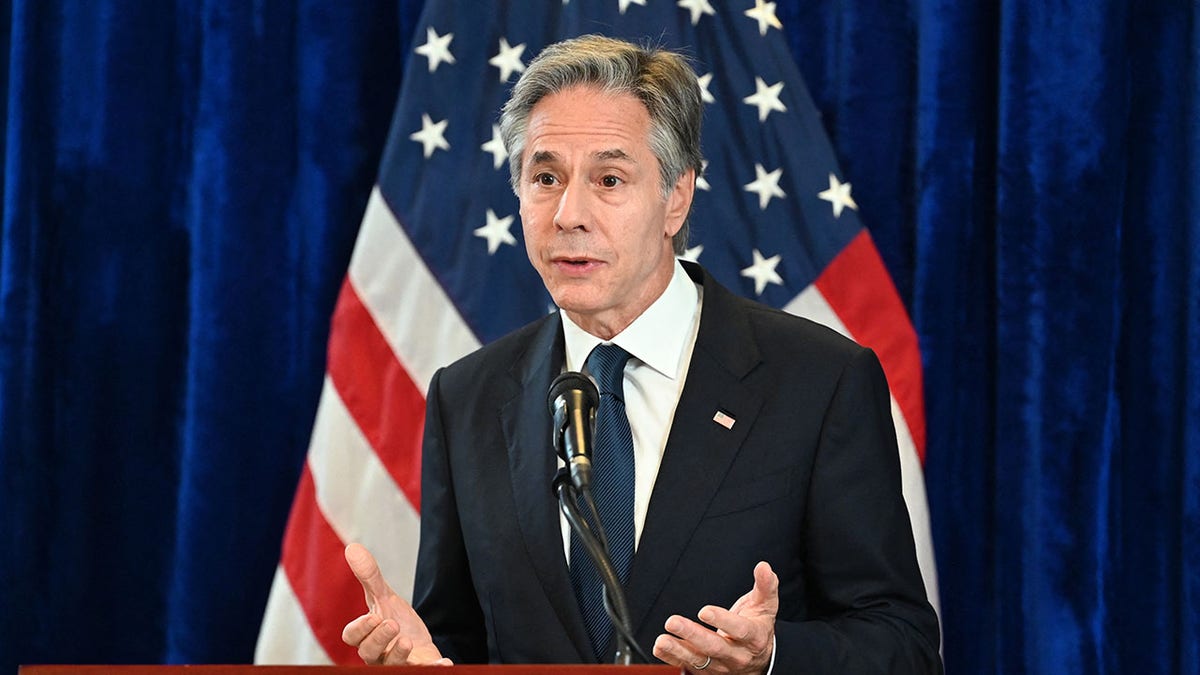
Antony Blinken, former Secretary of State, highlighted the potential disaster of a U.S. ground invasion in Iran. Speaking at the 24th Hindustan Times Leadership Summit in New Delhi, he emphasized that airstrikes alone may not suffice to dismantle Iran’s weapons capabilities. Blinken, who served under President Biden, noted Iran’s expansive territory and population of 90 million as challenges to such military efforts.
“The weapons that it continues to produce are back far enough, the range is great enough that you can’t just take everything out,” Blinken said. “You’d probably have to have a land invasion of some kind to do that, which would be an absolute disaster.”
Blinken’s remarks came as Iran reportedly launched six drones targeting a U.S. military base in Bahrain. The drones aimed at a radar system at Al-Rifaa base, according to Iranian state media, in retaliation for alleged hostile U.S. actions. Bahrain intercepted these drones successfully, marking the first such interceptions since September.
The ongoing conflict in Yemen, where Houthis advanced against Saudi-backed forces, adds to regional instability. Blinken warned of Iran’s ability to escalate conflicts, complicating U.S. military efforts. He stated that while Washington can intensify bombing, Tehran could target U.S. installations and allies through direct attacks or allied groups.
“Even though we’re much more powerful, that asymmetry in their ability to escalate horizontally as opposed to vertically is not to our advantage,” Blinken said.
The geographic position of Iran, including its vast coastline and weapons facilities, poses additional challenges. Iran’s size, about four times California, makes aerial elimination of its military capabilities highly complex.
In Iraq, concerns over a potential U.S. ground operation have risen. Iraqi officials resist proposals limiting trade and movement with Iran, fearing Iraqi land might be used for U.S. operations. Reports suggest Iraqi leaders have been briefed on a possible American ground offensive plan.
Iraqi Foreign Minister Fuad Hussein warned of the unsustainability of the current state of “no war and no peace,” indicating a shift could occur towards peace or conflict. He stressed the role of Iraq in diplomatic mediation, pointing to discussions with Iranian leaders.
“The region’s unstable security environment cannot continue indefinitely,” Hussein said.
Hussein opposed U.S. demands to close all but two border crossings with Iran, terming it a sanction against Iraqis. Meanwhile, the U.S. Central Command (CENTCOM) continues efforts to curb Iranian weapon shipments with Task Force Iron Gate, coordinating with other agencies to prevent illicit trade across Iran’s borders and the Caspian Sea.
Overall, the situation underscores complex regional dynamics involving U.S. strategies and Iran’s military capabilities.