
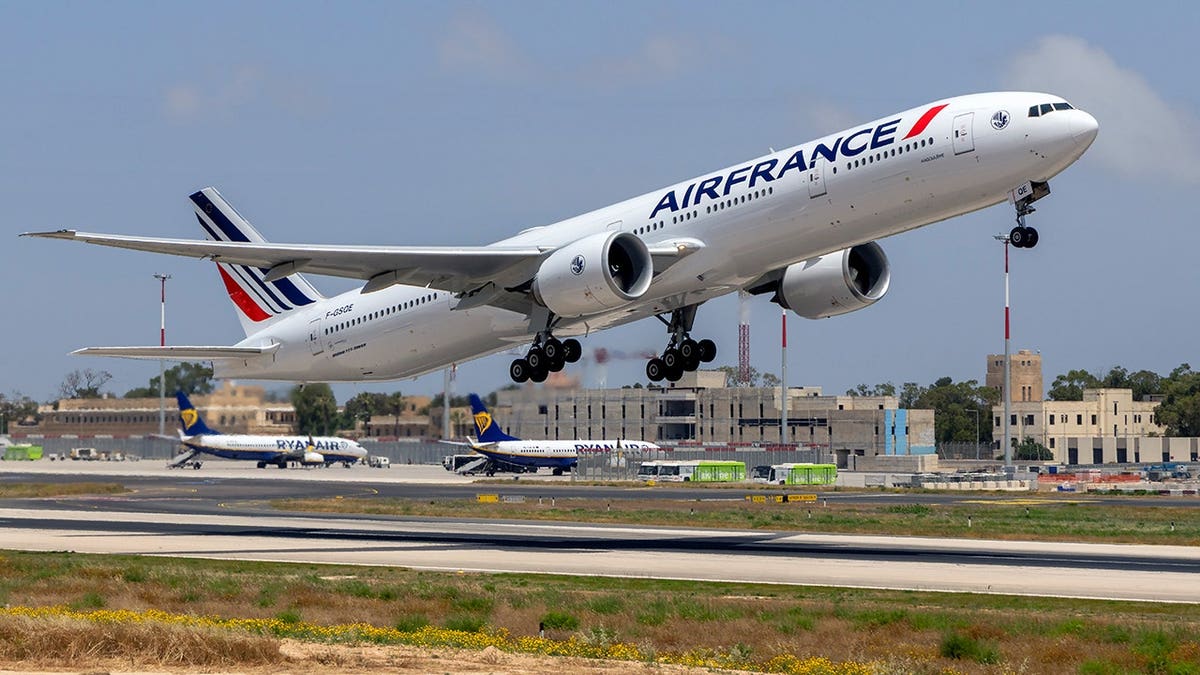
Two passenger jets, operated by Air France and American Airlines, experienced a close call shortly after departing from Los Angeles International Airport. This incident took place on November 7 at approximately 12:20 a.m., when the Air France flight made an unsanctioned turn, according to a statement from the Federal Aviation Administration (FAA) provided to Fox News Digital.
The crew of Air France Flight 28 made an unauthorized turn after departing Los Angeles International Airport and went into the path of another aircraft that departed from a parallel runway,
the FAA explained.
Recorded air traffic control communications reveal the urgent actions taken to avert a potential disaster.
Air France 028 heavy, fly heading of 270 immediately, a controller can be heard directing the Air France crew. The Air France plane, not pictured, had deviated from its expected trajectory after taking off from LAX and encroached dangerously close to an American Airlines plane that also recently took off.
Soon after, a traffic alert was issued to American Airlines Flight 1660. The warning informed its pilots of another aircraft less than a mile away and directly ahead.
Traffic alert, traffic 12 o’clock, less than a mile, maintain 2,000, the controller instructed.
An American Airlines pilot responded, OK, we’ll go back to 2,000.
Both airlines were contacted for comment.
Steven Arroyo, an aviation expert and retired airline captain, elaborated on the event, stating, Air France departed from the north side of Los Angeles Airport on a parallel runway from where an American Airlines aircraft took off. All of a sudden, unannounced, the Air France aircraft made an unauthorized left-hand turn toward the American Airlines aircraft.
He observed that the planes were within 400 feet of each other and less than a mile apart.
After resolving the immediate hazard, air traffic control questioned the Air France crew’s deviation from the assigned departure.
Air France 028 heavy, you were instructed to climb via SID, not turn to a heading,
said the controller. The SID, or Standard Instrument Departure, is part of flight clearance assigned to aircraft.
The crew later clarified that they were following the SUMMR TWO departure, an established departure procedure from LAX. Air traffic control issued immediate corrective measures after the deviation. The prompt actions by air traffic control were praised for preventing a collision.
Arroyo commented that although this was a critical situation, the air traffic controller handled the situation exceptionally well. He noted that such incidents in aviation are rare.