
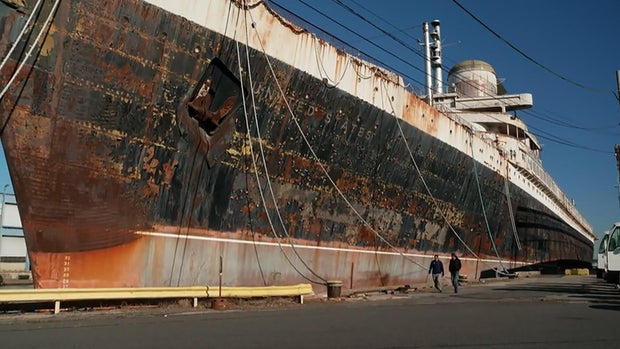
By November 8, 2026, the SS United States stands as a testament to maritime history. Despite her peeling paint and rust, she remains a striking figure in the North Atlantic, measuring five city blocks in length and 12 stories high. The SS United States made history as the fastest ocean liner, reaching speeds of over 40 miles per hour on her maiden voyage in 1952, a record yet unbeaten for transatlantic crossings.
In her time of service, the SS United States was not only fast but also marked by elegance and refinement. Over nearly two decades, she carried four U.S. presidents, numerous celebrities, and tens of thousands of passengers. However, with the advent of jet travel, her allure diminished. By 1969, the era of glamorous sea travel gave way to faster air transport, and the SS United States ceased operations.
Since then, she has remained docked in Philadelphia, her grandeur fading over three decades with only spiders and sunlight as companions. Yet, her presence remains undeniable. According to Susan Gibbs, president of the SS United States Conservancy and granddaughter of the ship’s designer William Francis Gibbs, the ship symbolizes American ingenuity and unity.
Originally built with significant investment from the U.S. military, the SS United States had the capability to transform into a troop ship within a day, capable of transporting an entire division. Today, her once grand interior lies empty, from a now-gone staircase to an indoor saltwater pool that now stands empty. Despite these losses, enthusiasm to preserve her persisted.
Various ideas emerged for her restoration, including museums, restaurants, and event spaces. However, plans remained unrealized, and her future seemed destined for dismantling. Then, a bold proposal surfaced: to transform her into an artificial reef. Alex Fogg, Okaloosa County’s natural resources chief, intends for her to become the largest intentionally sunken artificial reef worldwide.
Fogg’s county in Florida has a history of submerging vessels to foster marine life, but the SS United States presents an unprecedented challenge. Jennifer Adams, the county’s tourism director, embraced the opportunity despite emotional ties. The purchase price was $1 million, with an additional $13 million required to prepare her for submersion.
Amidst the preparation, the ship’s rich history and environmental considerations posed challenges. Her legacy touched many, including former passengers like Linda Sylva and fans who felt a personal connection. Jeffrey Smith, who never sailed on her, traveled from Detroit just to bid farewell.
In 2025, the SS United States began her journey southward, leaving Philadelphia behind. Despite her outdated state, she moved with elegance, reaching Mobile, Alabama, ahead of schedule for environmental remediation. In preparation for her submersion, holes were strategically placed to facilitate airflow and water passage.
Plans for her sinking place her 20 nautical miles offshore between Pensacola and Destin/Ft. Walton Beach, Florida. Her two iconic funnels will be preserved as part of a museum initiative by the Conservancy, which will display unique artifacts such as the tourist class smoking lounge bar.
As she prepares for her final voyage, the sinking of the SS United States offers a paradox of preservation through transformation. Her story will persist as part of the marine ecosystem, becoming a new habitat brimming with life. The ocean will embrace her, fulfilling a fitting legacy for a ship that once bridged continents and cultures.