
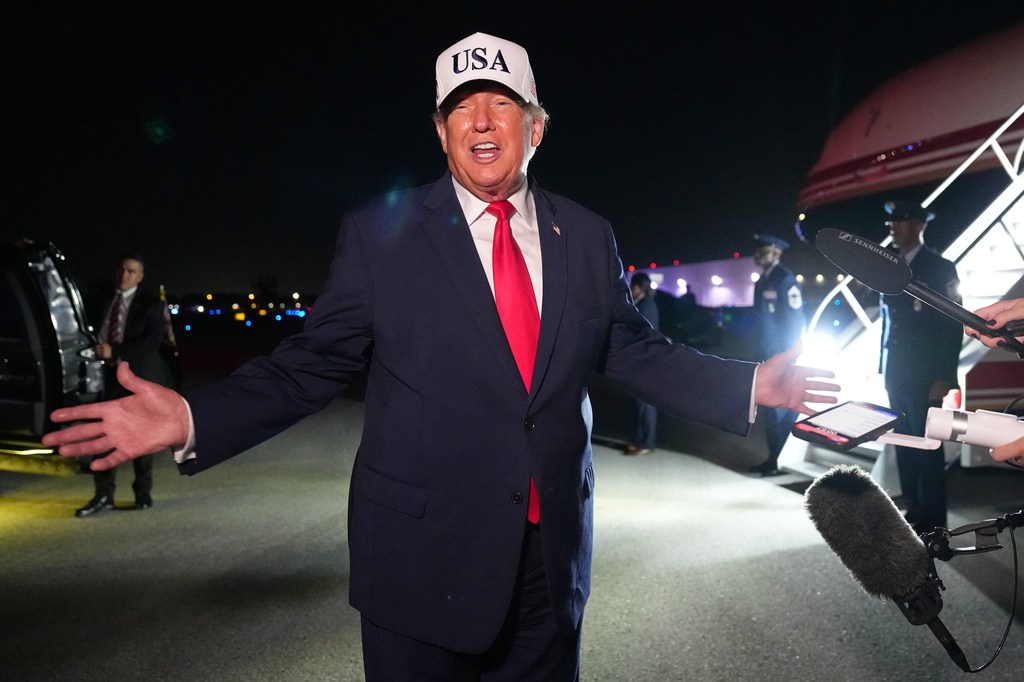
President Donald Trump expressed a willingness to work with Democrats after notable midterm election outcomes, including potentially collaborating on immigration. At the same time, he praised Stephen Miller, who was named as the incoming White House Chief of Staff, referring to him as an MVP. Miller is recognized for his strong influence on Trump’s stringent immigration policies.
Speaking near Kennedy Space Center in Florida at the UP.Summit, Trump responded to questions about possible Democratic-led initiatives he might support.
I think a lot,
Trump remarked, identifying immigration and tax matters as areas for potential cooperation. He mentioned the possibility of adjusting taxes for improved convenience and fostering economic development.
His remarks followed the announcement that Miller would replace Chief of Staff Susie Wiles after the Republicans experienced setbacks in the midterm elections.
Miller’s promotion could make bipartisan efforts challenging. USA Today labeled Miller as an immigration hawk, noting his advocacy for mass deportation and limited interest in working with Democrats.
Democratic leaders were quick to criticize Miller’s appointment. Senate Minority Leader Chuck Schumer mentioned their intention to challenge his approach, while House Minority Leader Hakeem Jeffries criticized Miller as a reckless extremist.
Trump endorsed Miller firmly when asked about his long-time aide in high regard, commending his loyalty and intelligence since 2015.
Miller’s strong role in shaping Trump’s immigration policy makes any mention of collaboration in this area notable for both parties.
Democrats responded to Miller’s rise with skepticism, as Schumer suggested Trump hadn’t learned from the election setback and Jeffries warned against Miller’s influence.
Trump offered thoughts on Republican losses in the elections, focusing on the Senate’s legislative stagnation, which he regarded as problematic.
We had a bad election because of a few things,
Trump stated, pointing to Senate inactivity and increased oil prices.
He emphasized the legislative gridlock, describing the Senate as a roadblock.
Specifically, he referred to the SAVE America Act’s failure to pass, which mandated proof-of-citizenship for voter registration, as a setback.
Although he did not attribute blame to Senate Majority Leader John Thune, he urged progress on legislation.
Trump also connected Democratic wins to the stock market downturn, citing a $3 trillion market drop post-elections. This viewpoint links the market fall to concerns about technology shares, artificial intelligence valuations, and data-center investments, despite Trump attributing it to Democratic successes.
In this charged political climate, Trump displayed an intent for bipartisan engagement, notwithstanding Democratic skepticism due to Miller’s ascendancy.
I’m very much open to it,
Trump concluded regarding collaboration across the aisle.