
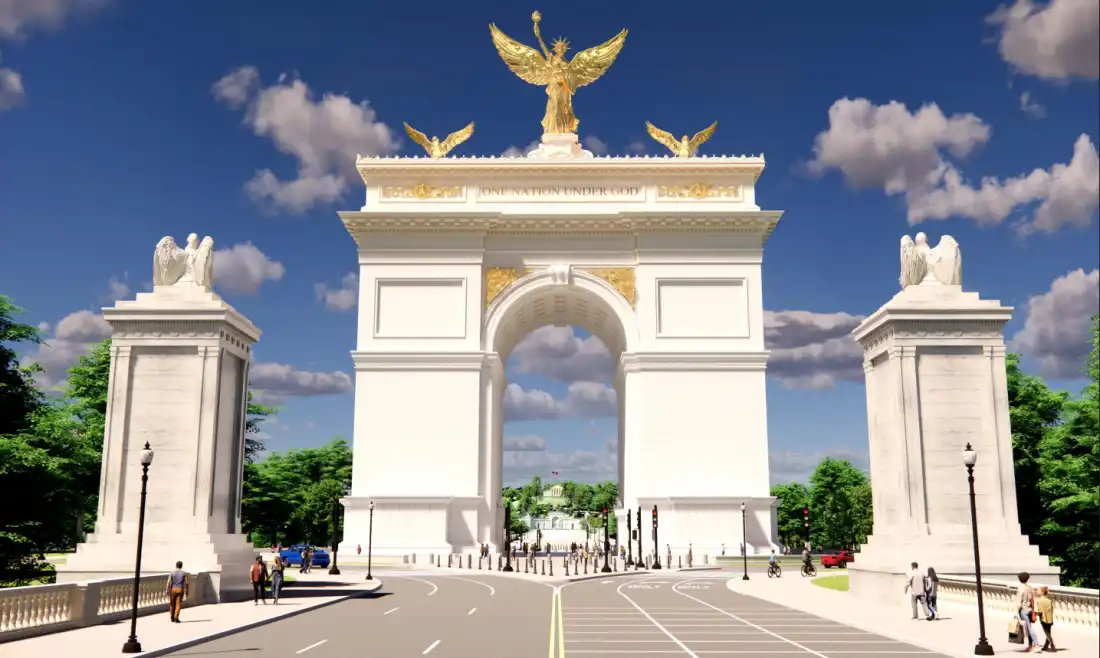
The government has put forward its final designs for a notable structure to the National Capital Planning Commission. This proposal includes a 250-foot arch crowned with three golden statues and an eternal flame. The Department of the Interior released these images, marking a significant step in President Trump’s ambition to build an arch in Washington, D.C.
Approval Disputes and Public Opinion
This week is pivotal for the project’s future. The Trump administration has pursued this giant arch aggressively, sidestepping Congress, and bypassing several federal checks. In May, the Commission for Fine Arts, exclusively appointed by Trump, endorsed the initial design. By September, a federal body, including Trump allies, ignored a preservation review, considered hasty by critics.
On Thursday, the National Capital Planning Commission will evaluate the project’s final approval. The arch is the sole agenda item for its online meeting, expected to witness high participation due to public interest. Nearly 120 citizens are scheduled to voice their concerns, indicative of the widespread opposition.
Democratic politicians, veterans, and historic preservationists, backed by over 100,000 individuals, have raised objections via comments and protests. Opponents argue the arch will obstruct views and insult veterans at nearby Arlington National Cemetery. They view the proposed structure as a self-serving effort by Trump to leave a permanent mark in the capital.
Trump’s Vision versus Public Backlash
The White House maintains the arch will “enhance the visitor experience at Arlington National Cemetery,” claiming it will become an iconic landmark worldwide. President Trump, at the Reflecting Pool, praised the project, highlighting it with other D.C. developments just before the midterm elections.
The planning commission is likely to approve the arch. It approved preliminary site plans earlier, and its chair, Mark Paoletta, a Trump appointee, supports the arch.
The administration states that post-approval from the commission and the Department of the Interior, construction can commence swiftly. Last month, the government hinted at construction beginning as early as the day of the commission’s decision.
Legal Challenges and Preservation Disputes
The planned location is a traffic circle on Arlington Memorial Bridge, between the Lincoln Memorial and Arlington National Cemetery. This site holds historical significance, previously owned by Confederate General Robert E. Lee. The Trump administration claims its right to build through century-old congressional permissions, though those columns were never constructed.
Opponents, including Vietnam War veterans and an architectural historian, have sued, claiming the arch lacks necessary congressional approval. They urge a judge to block any construction attempts. Advocacy groups also support this challenge.
During recent hearings, Judge Tanya Chutkan expressed doubts about the government’s urgency and national security arguments. D.C. and Virginia have also filed lawsuits against the arch, criticizing it for alleged legal violations and local disruptions.
Questions of National Security and Local Concerns
There are official claims about the structure being part of national defense, though exact plans remain vague. Defense Secretary Pete Hegseth described it as a “national defense opportunity.” Still, Judge Chutkan questioned its practical applicability as a security feature.
Despite ongoing legal wrangling, the government asserts that it can proceed without waiting for judicial conclusions. It faces strong resistance from local authorities and citizens over environmental and urban concerns.
The lawsuits claim illegal construction without Congress, citing federal preservation laws and unique D.C. building height restrictions. Local governments are wary of traffic issues and increased resource burdens due to the arch.
The Trump administration aims to complete this project in two to three years, arguing against judicial intervention because initial work won’t affect site views. Yet, opposing arguments highlight potential environmental harms and urban disruptions, complicating the ongoing legal and public debate.