
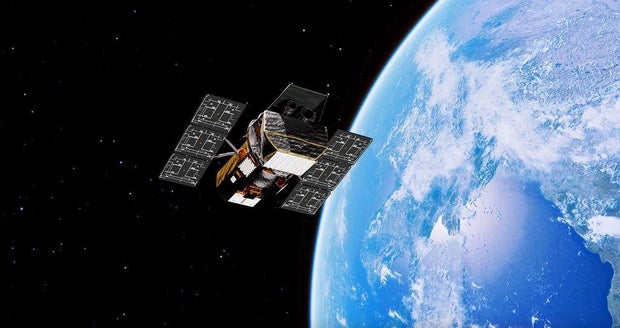
The Swift Observatory, a NASA telescope weighing 1.5 tons, has made its return to Earth after being launched over 20 years ago. The observatory reentered Earth’s atmosphere at 7:39 a.m. ET above North Sumatra, Indonesia, as reported by NASA. Most of the observatory disintegrated during reentry, but some parts are expected to land across various regions.
NASA and the U.S. Space Force tracked the reentry path of the observatory, estimating a reentry time of around 3:30 a.m. EST on November 4. There was an 11-hour uncertainty window for this prediction. According to NASA, the likelihood of harm occurring to anyone on Earth was minimal, with odds of about 1 in 2,100.
Launched on November 20, 2004, the Swift Observatory was initially intended for a two-year mission in low-Earth orbit. Its purpose was to investigate major galactic events, such as gamma-ray bursts and supernovas, using its unique ability to quickly maneuver towards such phenomena.
Despite its intended short mission, the telescope operated until just last month. Increased solar activity eventually forced the observatory back to Earth. NASA enlisted Katalyst Space in July to attempt a rescue with a robot named Link, but the mission was unsuccessful. Link was unable to get close enough to the telescope and fell back to Earth in September.
In August, the decision was made to let the telescope return to the planet. Observations continued until October when the orbit became too unstable, necessitating a shutdown of its systems.
“Swift has broadened our understanding of a wide variety of cosmic objects and events, from active galaxies powered by supermassive black holes and stars undergoing X-ray flares, to supernova explosions and comets and asteroids in our own solar system,” NASA noted in a blog post.
The telescope made significant contributions by observing over 2,000 gamma-ray bursts and 1,400 supernovas. It also supported the Hubble and Webb space telescopes by alerting them to celestial events that warranted further investigation.
John Nousek, who led the Swift control team at Pennsylvania State University, acknowledged the inevitability of the observatory’s demise. “Our fervent hope is that the lessons learned by the successes of Swift can be applied to new generations of space missions to accelerate our discoveries about the universe,” he stated.
As scientists assess how to replace the Swift observatory’s capabilities, the telescope’s legacy of enhanced cosmic understanding remains impactful.