
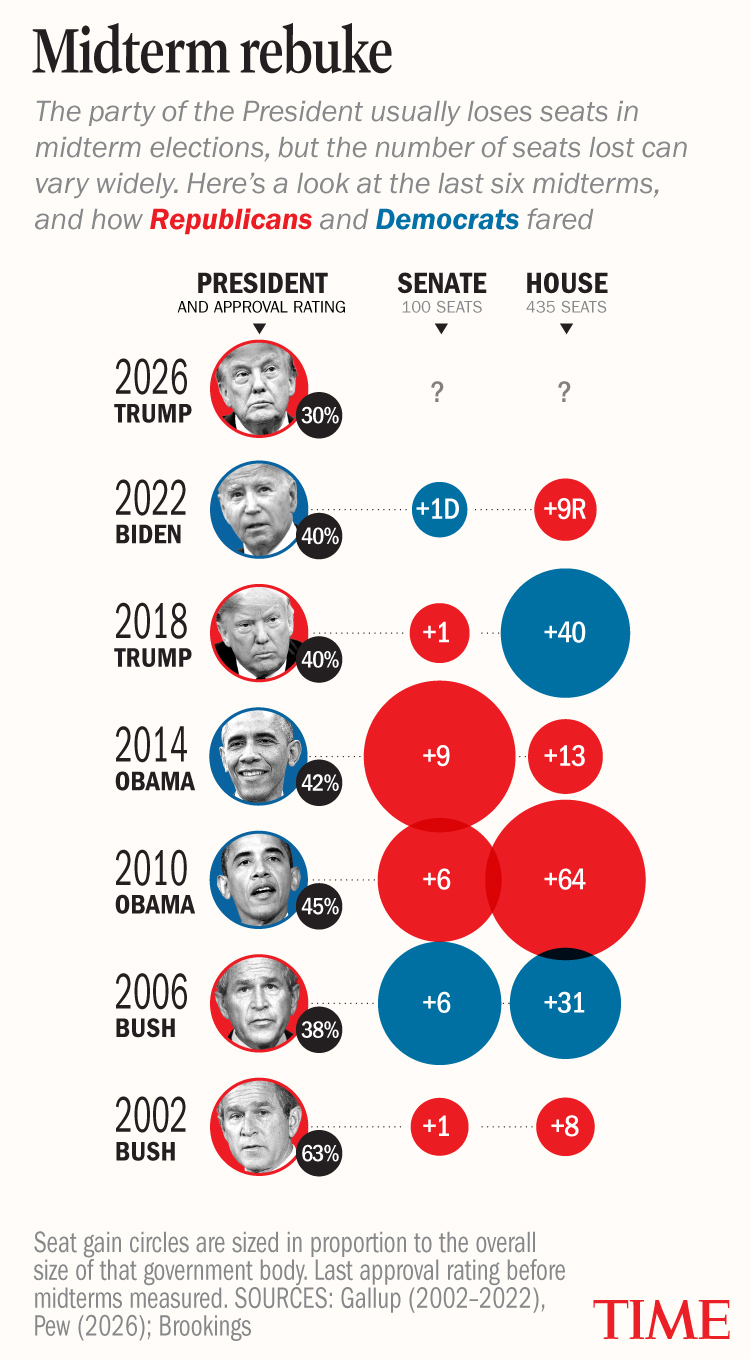
With the November elections approaching, President Donald Trump’s approval rating has dropped to its lowest point during his second term. According to the Pew Research Center, Trump’s approval rating fell to 30% in early October. This marks the lowest rating for a President entering the midterms in decades, comparable to Harry Truman’s approval in 1946.
Peter Enns, a government professor at Cornell University and co-founder of Verasight, notes that Trump’s approval is historically low. Data suggests dissatisfaction stems mainly from the economy. An Associated Press-NORC survey shows only 26% support Trump’s economic policies. Furthermore, only 17% of adults approve of his handling of the cost of living. In addition, the same poll reports only 28% support Trump’s approach to the conflict in Iran.
“Part of the reason Trump’s approval ratings are so low is he’s pushing policies and pushing positions that are unpopular,” Enns states. The public perceives the conflict in Iran and high gas prices as Trump’s decisions.
The economy is a top concern for voters, with 84% deeming it a “very important issue” for the midterms, according to Pew Research. Foreign policy is also crucial for 57% of voters.
Midterm elections are challenging for the sitting President’s party. Historically, the President’s party often loses congressional seats. Enns explains this phenomenon by noting that both supporters and opponents of a President may express frustration over unmet policy expectations.
“The backlash, the tides, are working against the incumbent President,” Enns points out.
Costas Panagopoulos from Northeastern University suggests voters might seek partisan balance. Especially when one party controls the White House and Congress. If policies are unsatisfactory, voters may support the opposition party.
Exceptions exist, such as the 2002 midterms when President George W. Bush’s Republican Party gained seats amid his high approval post-9/11.
There are times when expected opposition success doesn’t materialize. In the 2022 midterms, despite low approval for then-President Joe Biden, Republicans didn’t achieve the anticipated major victories. District redrawing and events like the overturning of Roe v. Wade possibly influenced the results.
Swers from Georgetown University notes that midterms act like a “referendum on the presidency.” A President’s approval rating is a vital predictor for midterm outcomes, capturing public sentiment about the incumbent’s performance.
Panagopoulos states, “A President’s approval rating is among the best predictors of midterm outcomes.” Lower ratings typically suggest greater congressional losses for the President’s party.
For Republicans, Trump’s low rating and Democrats’ enthusiasm suggest a difficult political climate. Generic ballot polls show Democrats leading and more eager to vote, with 91% of Democrats compared to 86% of Republicans expressing enthusiasm.
Panagopoulos predicts Republicans may face challenges, potentially losing seats in both congressional chambers. Yet, flipping majorities in the House or Senate can be difficult.
Enns reminds that polling serves as a “snapshot in time,” highlighting that it remains uncertain who will vote until Election Day itself.