
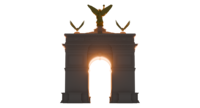
Washington’s central area features careful geometry and planned sight lines. From the Lincoln Memorial, across a bridge over the Potomac River, Arlington National Cemetery sits prominently in the distance. A proposed 250-foot-tall arch by President Donald Trump aims to become a significant landmark in this space. To assess its effect, The Washington Post constructed a to-scale digital 3D model.
The model shows that over a year, the shadow of the triumphal arch would reach burial sites in Arlington National Cemetery on 284 days. Kennedy’s eternal flame would lie under its shadow on 18 days. The former president’s memorial would be shaded on 50 days. The Military Women’s Memorial would darken on 109 days. It would cast its shadow across the graves of veterans from various wars, including the Vietnam War, Korean War, and both World Wars. It would dim the headstones of previously enslaved individuals. Overall, the shadow would cover more than 75,000 graves.
Most days, the shadow would fade from the grounds by 8 a.m. However, on 26 days, it would linger past opening time. White House spokesman Davis Ingle stated that the arch would enhance visitors’ experience. He described it as an iconic landmark set to attract global recognition.
The Interior Department indicated that only a small section of the cemetery would be affected after its opening. They mentioned that this period coincides with early morning when shadows are exaggerated. The department provided visual simulations showing shadows after the cemetery opened but did not disclose the methodologies used. The locations of the shadows aligned largely with The Post’s analysis.
The planned size and position of the arch, approximately a quarter-mile from the cemetery, have raised concerns among historians, preservationists, and architects. They argue that it might disrupt the long-established composition of the capital. Neil Flanagan, an architect and historian, noted that Washington’s design prioritizes open spaces between significant structures, which are as crucial as the landmarks themselves. A towering arch between the Lincoln Memorial and the military cemetery does not align with this vision.
Micki McElya, a history professor, highlighted the symbolism of Trump’s arch casting shadows on the cemetery. Whether or not these shadows appear only briefly, the symbolic impact remains significant. Her insights are drawn from extensive research on Arlington National Cemetery.
At sunset, the arch’s shadow would extend across the Arlington Memorial Bridge and influence eastern monuments. The morning shadow would touch Kennedy’s grave during the warmer months, while the evening shadow would affect Abraham Lincoln’s memorial in colder months. On 110 days annually, a monument to an assassinated president would be under its shadow.
Parts of the Martin Luther King Jr. Memorial would fall under the arch’s shadow on over 30 days, including the Reflecting Pool area. Its evening shadow would sometimes reach the memorials of Vietnam and Korean War veterans.
The model does not include shadows from trees or other structures, focusing solely on the arch. Concerns arise from the monument’s shadow affecting the resting places of veterans and prominent Americans. Paul Eaton, a retired U.S. Army major general, emphasized these points. VoteVets, an advocacy group for military veterans, opposes Trump’s project. They raised important concerns and provided their analysis before The Post conducted its own.
Karla Rothstein, an architect expert in urban public spaces, expressed that shadows derive meaning from their source. The concern revolves around a triumph monument imposing on a landscape commemorating sacrifice.
Despite persistent criticism about size, location, and design, Trump remains dedicated to the project. His administration is contesting a lawsuit by Vietnam War veterans and a preservationist seeking to halt the project. Trump’s deputies are also working on altering the height restrictions in Washington to support the arch.
Trump envisions the arch larger than Paris’s Arc de Triomphe, which stands at 164 feet. His administration plans to commence construction soon after securing necessary approvals. They also aim for year-round daylight saving time, impacting how often the shadow touches the cemetery.
Concerns are particularly focused on how the shadow might impact Kennedy’s memorial and its eternal flame. Jacqueline Kennedy, John F. Kennedy’s widow, emphasized the importance of visible recognition of her husband’s grave. The administration intends to place an eternal flame on Trump’s arch, adding to the complex symbolism.
The eternal flame burns in Arlington in 2013, on the 50th anniversary of President John F. Kennedy’s death. Photo: Jacquelyn Martin/AP
To analyze the shadow accurately, The Post created a 3D model using plans from the Trump administration. They utilized U.S. Geological Survey data to represent terrain and features and imported these into Blender. The model included data from NOAA to simulate the sun’s position daily. They verified its accuracy against satellite images of existing shadows from landmarks like the Washington Monument. To measure the shadow’s impact on graves, data from the Arlington National Cemetery Explorer provided the number of graves in affected sections.