
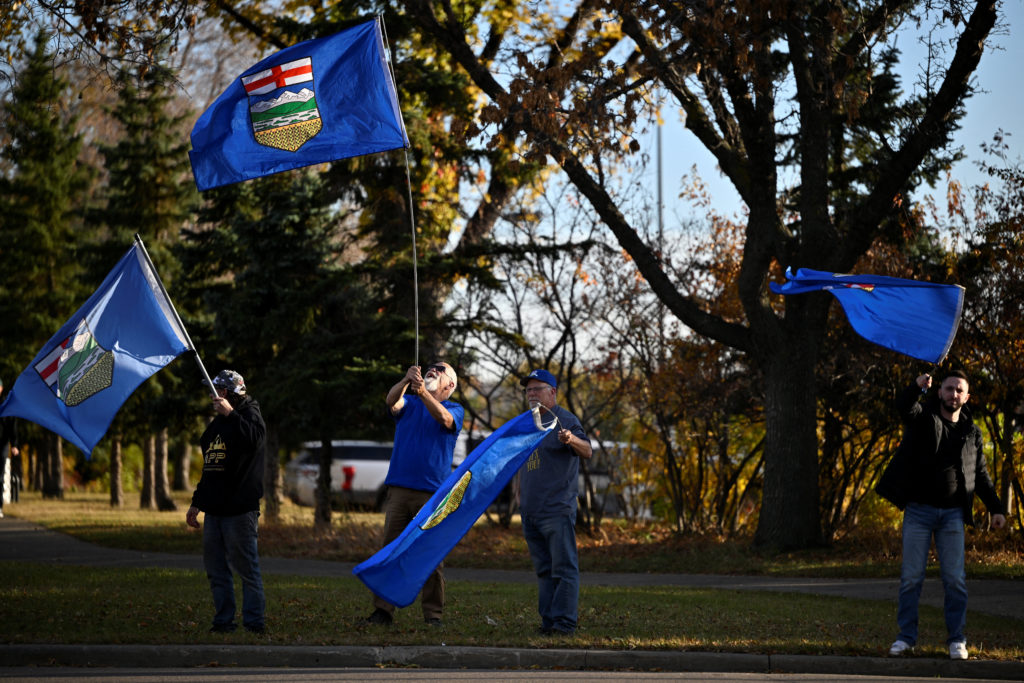
EDMONTON, Alberta (AP) — Alberta has long debated the topic of separation from Canada. On October 19, voters will decide whether to start the process leading to a future referendum on this issue.
Premier Danielle Smith has expressed her support for remaining in Canada, although 23% of recent poll respondents favor beginning the separation process. Smith called the vote as a means to assess the sentiment in Alberta, a region with significant oil reserves.
Alberta’s history of conflict with the federal government, particularly over energy policy, has fueled separatist sentiments. Liberal prime ministers Pierre Trudeau and Justin Trudeau have been unpopular here due to their climate policies and the national carbon tax, which Alberta leaders argue harm the oil industry.
Former Alberta Premier Jason Kenney stated that separatist parties historically received only a minimal share of votes.
The pandemic and the Freedom Convoy, which opposed vaccine mandates and disrupted Ottawa and key border crossings, have accelerated separatist movements. Jeff Rath, an independence leader, attributed this shift to federal vaccine rules stopping unvaccinated Canadians from flying, which acted as a tipping point for his support for separation.
The 2022 Freedom Convoy began with truckers protesting vaccine mandates but expanded to a wider opposition against pandemic restrictions. Social media played a crucial role in organizing activists who were formerly isolated.
Kenney observed that the separatist movement became more organized and professional, acquiring resources and political expertise. He noted overlap between separatist activists and supporters of Russian President Vladimir Putin and conspiracy theorists about Ukraine.
Kenney described the MAGA movement as influential for some activists. He claimed separatists attempted to infiltrate the United Conservative Party, appealing to those upset by COVID-19 restrictions.
Alberta’s political landscape sees Prime Minister Mark Carney gaining uncommon support due to his focus on expanding Alberta’s oil markets and endorsing a pipeline to the West Coast. Carney’s preference for business- and energy-friendly policies contrasts with U.S. President Donald Trump’s trade war, increasing his popularity in conservative Alberta.
Kenney, though a strong critic of Trudeau’s approach to Alberta, believes Carney resonates with Albertans’ grievances and aspirations.
Rath considers Carney a strong adversary but remains committed to the separatist cause, aiming for notable support in the vote.
Alberta separatists have taken their campaign to the United States, discussing plans and opportunities for an independent Alberta. Rath claimed meetings with U.S. officials touched upon topics such as an oil pipeline through the U.S. to the Pacific.
The U.S. State Department clarified its engagements with various representatives and stated the decision is for Alberta’s people.
Kenney criticized these meetings as inappropriate since the independence cause has no democratic mandate.
Keith Wilson, another independence advocate, considers the vote a strategic move to gain more negotiating power with Ottawa without pursuing full independence.
Wilson acknowledges that any significant structural changes in Alberta’s relationship with Ottawa could be a step forward.
Kenney believes that even modest support for separatism could embolden the movement, posing challenges to Alberta’s conservative landscape.
Alberta is not alone in Canada’s national unity struggles. Quebec’s Parti Quebecois won power on October 5, though similar separatist support remains low. Quebec has twice voted against independence, with the last vote in 1995 narrowly rejecting it.
A free press remains integral to democratic processes. Supporting reliable journalism helps foster informed dialogue.