
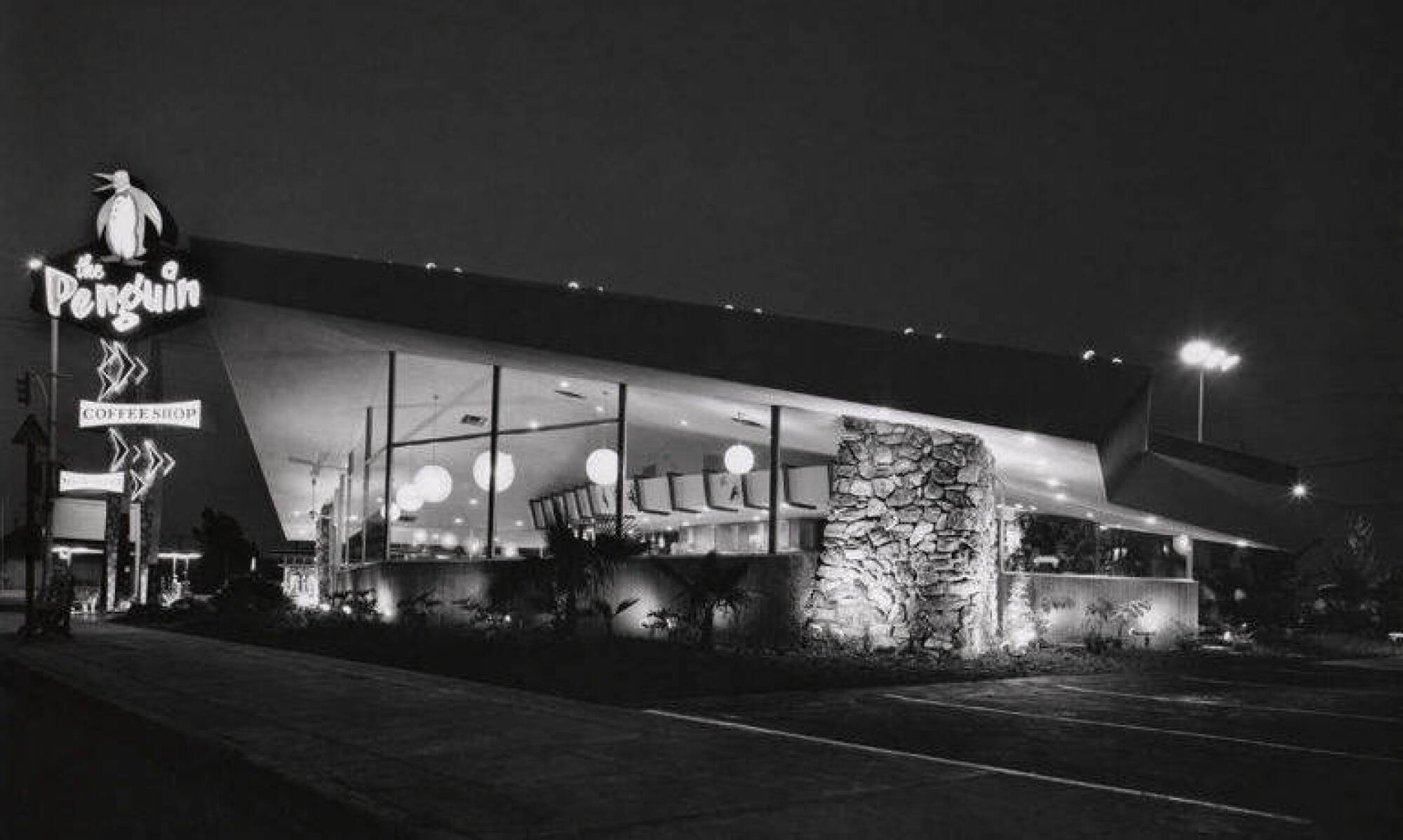
The mid-century structure standing at Lincoln and Olympic boulevards in Santa Monica serves as the iconic end point for the 2,400-mile Route 66 journey. Once a home to the Penguin Coffee Shop, the building now houses Mel’s Drive-In. However, its future is at risk as the owners have filed initial paperwork to demolish it and erect an eight-story apartment complex.
Preservationists aim to secure a historic designation to protect the site. The Santa Monica Landmarks Commission will evaluate the building’s nomination for landmark status, a proposal backed by both the Santa Monica Conservancy and the Los Angeles Conservancy. Supporters argue the building is an exemplary representation of Googie architecture by the renowned architects Armet & Davis. This style, characterized by dramatic slanted roofs and large neon signage, gained popularity among diners, car washes, and bowling alleys in the mid-20th century.
Nina Fresco, vice president of the Santa Monica Conservancy, stated, “This isn’t about saving a modern restaurant. It’s about preserving Googie architecture.”
ValueRock Realty purchased the half-acre site for $6.2 million in 2020 and later placed it on the market for $26 million. Subsequently, both conservancies nominated the building for landmark status, gathering $6,800 to cover nomination costs. Despite these efforts, ValueRock submitted a preliminary application to replace the building with an apartment complex featuring 138 units, 123 parking spaces, and retail space.
The building’s past includes hosting the Penguin Coffee Shop from 1959 to 1991, drawing diners with its bold design and rapid service. Though not Michelin-rated, it garnered praise, with critic Charles Perry citing it as the best diner in the area in 1989. The building found new life when the Mel’s chain renovated it to reflect its 1950s roots, reopening in 2018 while retaining key design elements.
The proposed apartment project has stirred debate. If landmark status is achieved, the building might be saved from demolition. However, owners can still appeal. Fresco noted that the team hopes to see a compromise where the existing structure coexists with new developments, citing other local projects that balanced historic preservation with new construction.
Rhys Martin, manager of the National Trust’s Preserve Route 66 initiative, emphasized, “This site, like Route 66 itself, represents something greater than itself.”
Route 66, extended to Santa Monica in 1935, remains an attraction. While the Santa Monica Pier is often thought of as the endpoint, the official terminus is where Mel’s now stands. The building’s location capitalized on being at the crossroads of Route 66 and the developing freeway system, drawing motorists from different eras.
As the debate unfolds, the building continues to welcome patrons, assured by a lease running through 2029. The potential for landmark designation carries significant implications for both the building’s preservation and the planned development.