
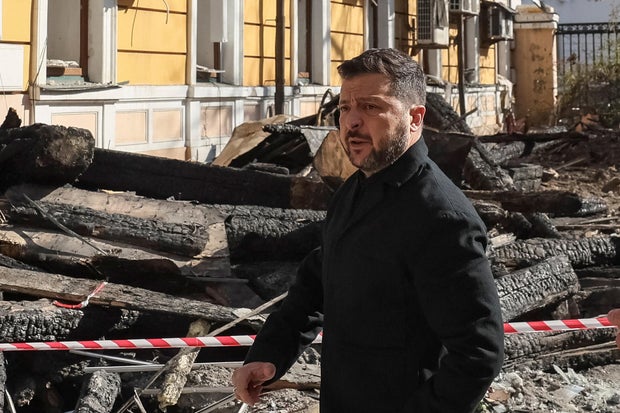
On Monday, Ukraine’s President Volodymyr Zelenskyy stated that there is no sign of Russia adhering to an energy ceasefire announced by President Trump. Following Trump’s announcement, Russia allegedly targeted a power plant in eastern Ukraine. By Monday afternoon, additional attacks affected six more energy facilities across Ukraine.
Zelenskyy assured that Ukraine would uphold the energy ceasefire and called on Russia to do the same. He posted on X, expressing a lack of evidence that Russia is following the ceasefire terms set by President Trump.
Responding to questions about Russia’s violations, Trump said he was unsure and would review the situation. He emphasized that both Zelenskyy and Russian President Vladimir Putin need to negotiate to end the conflict. Trump remarked that there have been breaches on both sides.
Trump conveyed that he believes Putin is more inclined to reach a deal than Zelenskyy. Over the past year, Trump’s attempts to broker agreements to protect energy infrastructure between Russia and Ukraine have either failed or been quickly breached.
In January, Trump asserted that Putin agreed to halt strikes on Ukrainian energy facilities for a week, but within four days, Russia attacked Kyiv’s power and heating infrastructure. In another instance in September, although Trump stated that both Putin and Zelenskyy had consented to refrain from targeting each other’s energy infrastructure, neither side stopped the attacks. Zelenskyy, during a CBS News interview, expressed willingness to agree to a moratorium but doubted Russia’s commitment.
Russia’s resistance arises because their attacks substantially impact Ukraine’s energy infrastructure more than Ukrainian attacks affect Russia. Ukrainian strikes usually aim to disrupt Russian oil and gas infrastructure, impacting revenues vital for Russia’s war effort.
According to the International Energy Agency, Russian oil refining has declined to a 20-year low with a 30% reduction in diesel production in 2026. However, Russia’s economy remains solid. Alexander Kolyandr from Eurasia Group mentioned that Ukrainian attacks are inconvenient and inflationary for Russia but don’t destabilize its economy.
Russia, with a larger economy and more military resources, can impose significant pressure on both Ukraine’s economy and civilians. Ukraine is experiencing power outages as its power grid faces intense pressure from Russian strikes as winter approaches.
Kolyandr highlighted that with Ukraine’s smaller economy, the impact is more severe. Russians don’t differentiate between civilian and military infrastructure, considering all as potential military resources.
Last winter, with Ukrainians enduring frequent power and heating outages, Trump appealed to Putin to cease targeting energy infrastructure. This week, Trump directed pressure towards Ukraine, coinciding with high global energy prices, which he attributes more to the Russia-Ukraine conflict than other conflicts.
Trump announced a new deal allowing Russia to sell diesel to U.S. and global markets, reversing previous American policies to block Russian petroleum sales.
A European and a Ukrainian official disclosed to CBS News that the Trump administration threatened to stop intelligence sharing and suspend U.S. weapon sales to European allies supporting Ukraine, if Ukraine does not halt attacks on Russian energy sites.
The Ukrainian official remarked that Ukraine takes these threats seriously, as intelligence sharing is crucial for missile launch tracking, and the PURL program enables Ukraine to purchase key defense missiles like the Patriot, which are scarce.
The threats were first reported by the Financial Times. CBS News reached out to the White House for comments.
Zelenskyy contends that moving toward an energy ceasefire depends on the U.S. exerting more pressure on Russia, suggesting that America’s stance is crucial for de-escalation success. “Pressure on Russia is needed,” he stated on X.