
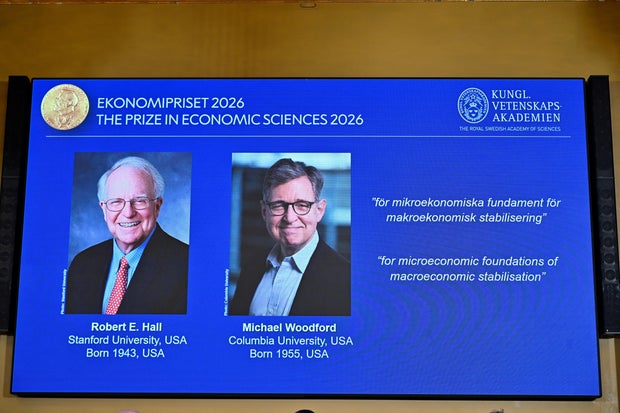
On Monday, American-born economists Robert E. Hall and Michael Woodford were awarded the Nobel memorial prize in economics. Their work has contributed significantly to how governments and central banks handle economic fluctuations. The Royal Swedish Academy of Sciences revealed the laureates in Stockholm, praising them for establishing microeconomic foundations for macroeconomic stabilization.
In a statement, the academy noted, “The laureates have helped us smooth out the economy’s peaks and troughs.” Hall, an 83-year-old economist affiliated with Stanford University, along with Woodford, born in 1955 and associated with Columbia University, have been recognized for their impactful contributions.
Michael Woodford expressed his surprise and honor during a phone conversation from New York, stating, “It’s a tremendous honor, it’s a surprise.” John Hassler, chair of the Committee for the Prize in Economic Sciences, emphasized the importance of their work: “The laureates’ work has provided us with a stable theoretical foundation for the models now used by central banks and governments worldwide.” With their models, economies can better respond to challenges like energy crises or changes in consumer behavior.
Historically, economic shocks have been addressed using the strategies of John Maynard Keynes, centered around reducing taxes and increasing government spending. This approach aimed to boost consumer and business spending. However, as noted by Timo Boppart of the Nobel economics prize committee, this “Keynesian recipe” encountered limitations during the “stagflation” period of the 1970s, marked by concurrent high inflation and unemployment. Hall and Woodford constructed improved models reflecting real decision-making by consumers and businesses regarding investments and expenditures.
Last year’s Nobel economics prize was awarded to researchers focusing on business innovation, promoting economic growth through new products and inventions. The economics prize, formally known as the Bank of Sweden Prize in Economic Sciences in Memory of Alfred Nobel, was instituted in 1968 as a tribute to Alfred Nobel, the inventor of dynamite.
Notably, most economics laureates have hailed from the U.S., with only three women among the recipients, including Claudia Goldin in 2023 for her work on gender dynamics in employment and pay. While the economics prize is not a official Nobel Prize, it is presented alongside the other awards annually on December 10th, marking Nobel’s death anniversary.
This year’s prize includes 12 million Swedish kronor, approximately $1.2 million, allocated to individuals, groups of laureates, or organizations. Last week’s Nobel honors were given in medicine, physics, chemistry, literature, and peace categories.