
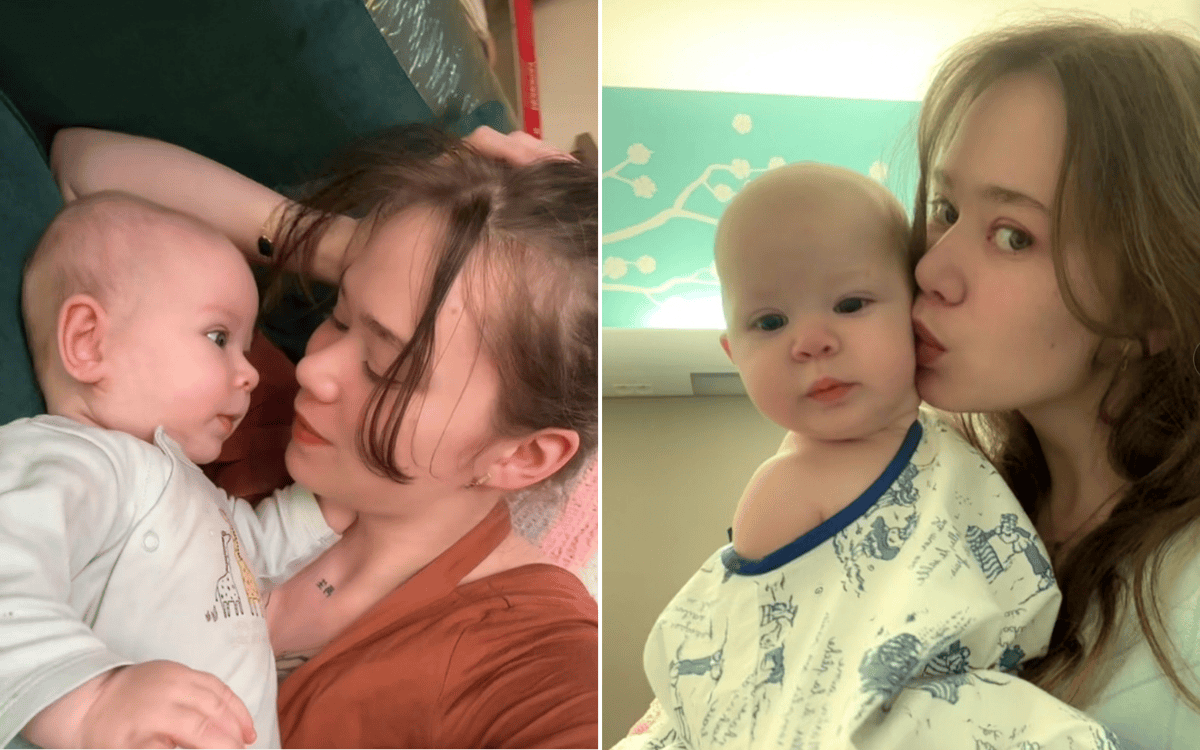
Marcelle Miller faced a profound change in her life after her three-month-old daughter was diagnosed with a rare congenital condition. Until then, Miller’s pregnancy had progressed smoothly.
“My pregnancy went really well,” she shared with Newsweek. Despite a minor issue with a placental hematoma that resolved with rest, she experienced no morning sickness. It felt like a dream pregnancy.
At 22, Miller was a thriving realtor in Europe. Her daughter was born after an extended labor of 42 weeks and 21 hours but arrived healthy, with the actual delivery taking only seven minutes. “Everything was perfect,” Miller said.
When her daughter reached three months, Miller noticed a subtle change. “I saw a faint cloudy ring in her right eye,” she explained. Though it was barely visible, Miller grew concerned and sought medical advice. Searching online, she came across information about congenital cataracts.
Understanding Congenital Cataracts
Congenital cataracts occur when a newborn has a cloudy lens in one or both eyes, affecting roughly three to four out of every 10,000 births in the U.S. This condition can impede vision, make the pupil appear white, and lead to misaligned eyes. Treatment often includes surgery in infancy, supplemented by glasses, contact lenses, and visual therapies.
Despite hoping for another explanation, Miller’s fears were confirmed weeks later. Her daughter was diagnosed with bilateral congenital cataracts, leaving Miller devastated. “I cried for a week,” she recounted, feeling that her daughter’s future was uncertain.
Miller had to come to terms with altered expectations for her daughter’s life. She explained, “As parents, we all have dreams for our children. Realizing that their path might differ can be difficult.” Without personal experience with vision issues, the challenge felt enormous for Miller.
Congenital cataracts may derive from genetic mutations, inherited conditions, infections during pregnancy, or developmental eye problems before birth. Often, a precise cause remains unidentified. In Miller’s case, a possible link to a genetic mutation in her daughter’s father was found, though not a direct cause.
The family continues to seek further information as investigations proceed.
Steps Toward Healing
Miller acted swiftly to secure her daughter’s treatment. “The condition is serious,” she acknowledged. A specialist was recommended for intervention. “Congenital cataracts need specific treatments,” Miller emphasized. Early interventions are crucial, as untreated cataracts can hinder visual development.
Since the diagnosis, her daughter undertook four surgeries to replace the clouded lenses with artificial ones. Future visual aids such as glasses or contacts will be necessary. In some cases, therapies like eye patching help develop the weaker eye.
Although reluctant to wear glasses, Miller’s daughter adapts slowly, with her eyesight stable despite a lack of visual aids post-surgery. To outsiders, her condition remains hidden.
Miller reflected on the emotional toll the diagnosis took on her. “She was little, but seeing her like that hurt me deeply,” she revealed.
Although more surgeries are expected, Miller holds hope they may become less invasive over time. She envisions a limitless life for her daughter.
For other parents facing similar experiences, Miller offers a message of hope. “I’ve been in their shoes, filled with fear and uncertainty,” she said. “But our children can lead normal lives. The change lies with us as parents, adapting our expectations.”