
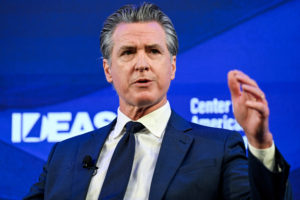
As the political arena primarily focuses on the imminent midterm elections, a less conspicuous yet significant shadow primary for the 2028 presidential contest is unfolding. Democratic and Republican presidential hopefuls are traversing the country, raising funds, and leveraging their political networks to support their parties’ candidates and propel their own White House ambitions.
Gavin Newsom Targets Southern States
California Governor Gavin Newsom is ending his tenure as governor this year and has been actively involved in the midterms. Newsom has concentrated on the Southern states, campaigning for candidates across Alabama, Mississippi, North Carolina, and particularly South Carolina, which holds the Democratic Party’s first presidential primary in 2028.
Newsom’s Southern involvement is linked to his Campaign for Democracy initiative, aimed at bolstering Democratic presence in traditionally Republican states.
This approach may also enhance his appeal among African American voters, a key demographic within the Democratic base. Newsom’s influence and extensive email list have fostered strong relationships with key Democratic figures in Nevada and New Hampshire, leading to successful fundraising campaigns.
Newsom played a significant role in backing Proposition 50, California’s response to Texas’s mid-decade gerrymandering. This measure, approved last year, could enable Democrats to gain up to five additional U.S. House seats. His involvement in redistricting battles might become a talking point during his presidential campaign, but his message might lose impact if Democrats don’t secure all five seats.
JD Vance’s Connection to Trump
Vice President JD Vance’s political future is tightly interlinked with President Donald Trump and the Republican Party’s performance. Vance has vigorously campaigned across the Midwest, South, and even Alaska, with a focus on combating election fraud.
Ohio remains a pivotal state for Vance, where he previously served as a Senator. The current Senate race involves Republican Sen. Jon Husted, facing a formidable challenge from former Democratic Sen. Sherrod Brown. In the gubernatorial race, Democrat Amy Acton competes closely with Republican Vivek Ramaswamy.
Turning Point Action’s effectiveness will be closely monitored, having endorsed Vance’s potential presidential campaign.
Vance has stated he is concentrating on aiding Republican candidates rather than pursuing a presidential run.
Josh Shapiro’s Pennsylvania Focus
Pennsylvania Governor Josh Shapiro is less involved in regional campaigns outside his state, responding by focusing on Pennsylvania’s significant swing status. As a potential presidential candidate, Shapiro’s strength lies in his influence within Pennsylvania.
Projected to win reelection over Republican State Treasurer Stacy Garrity, Shapiro has redirected his efforts toward helping Democrats secure control of the state legislature in November, working to flip four congressional seats.
Success in swing counties like Beaver, Luzerne, and Erie could help Shapiro vouch for reclaiming working-class voters who drifted away during the Trump era.
Andy Beshear Balances Risk and Reward
Kentucky Governor Andy Beshear, chair of the Democratic Governors Association, has bolstered his national image during the midterms. Beshear plans to kick-start a voter mobilization tour across key states, beginning with Nevada.
Beshear’s choices as head of the governors association provide both high risk and potential reward for future campaigns. Supporting Democrat candidates in traditional swing states like Wisconsin, Michigan, and Arizona, along with Republican-leaning states like Ohio and Iowa, Beshear stresses these areas’ importance for a future presidential campaign.
A recent million-dollar allocation to assist Texas gubernatorial candidate Gina Hinojosa underscores the pressure Beshear faces to deliver resources.
Ted Cruz’s Continued Campaign Efforts
Texas Senator Ted Cruz remains an active force in his party’s campaigning and fundraising efforts. His Truth and Courage PAC has spent substantial amounts on ads promoting midterm candidates, particularly supporting Senate candidate Ken Paxton.
Cruz’s travels have included visits to Iowa, a critical state in the Republican nominating process, and he plans further trips to Alaska, South Carolina, North Carolina, and likely Michigan.
JB Pritzker’s Financial Contributions
Illinois Governor JB Pritzker, while seeking reelection, has prioritized assisting candidates in other states. His donations to the Democratic Party total $38 million, involving both personal funds and contributions through his Ready for the Fight PAC.
Pritzker’s major focus has been the Texas governor’s race, contributing over a million dollars in support, and he’s actively involved in speaking engagements nationwide.
Ocasio-Cortez’s Progressive Testing Ground
Represented by Alexandria Ocasio-Cortez, New York’s progressive lane within the Democratic Party aims to scale nationally. Ocasio-Cortez supports Michigan Senate candidate Abdul El-Sayed, asserting his campaign as a critical evaluation for the progressive movement.
If El-Sayed triumphs in Michigan, it could signify broader acceptance of progressive politics in traditionally moderate regions.
Ocasio-Cortez acknowledges challenges in appealing to a nationwide voter base and views a Michigan victory as an opportunity to shift perceptions.
Pete Buttigieg’s Nationwide Engagement
Since stepping down as transportation secretary, Pete Buttigieg has utilized his time to campaign extensively for Democrats. Buttigieg endorsed nearly 100 candidates, visiting 37 states to bolster their campaigns.
Buttigieg’s wide-ranging appearances reflect his popularity within the Democratic Party, breaking into heavily Republican areas, such as campaigning with Nancy Lacore in South Carolina.
A unity event in Michigan in August highlighted Buttigieg’s capability to unite Democratic candidates after intense primary contests.