
In a recent meeting, ProPublica journalists discussed the ease with which individuals can establish private schools in many states. There seemed to be little to no regulation regarding experience, training, or curriculum. Curious about these loosely enforced standards, the team entertained the idea of founding a private school themselves to test this apparent leniency.
Exploring the Possibility
The reporters, experienced in covering education but not in running schools, decided to investigate further. The primary questions were about the level of oversight in school operations and the process for obtaining public funds.
Testing the Theory
ProPublica’s investigation indicated rapid growth in private schools, supported by taxpayer-funded vouchers. These schools emerged in various unconventional locations, yet faced minimal state monitoring. The team drew inspiration from previous investigative experiments such as John Oliver’s establishment of a tax-exempt church in 2015 and the Mirage Tavern operation by undercover reporters in the 1970s.
Setting Ground Rules
ProPublica made clear intentions to not operate schools or enroll students. Transparency was emphasized in applications, using their own contact details. The team declared they would halt their experiment if it required illegal actions or benefited from public resources improperly.
Collaborating with Local Newsrooms
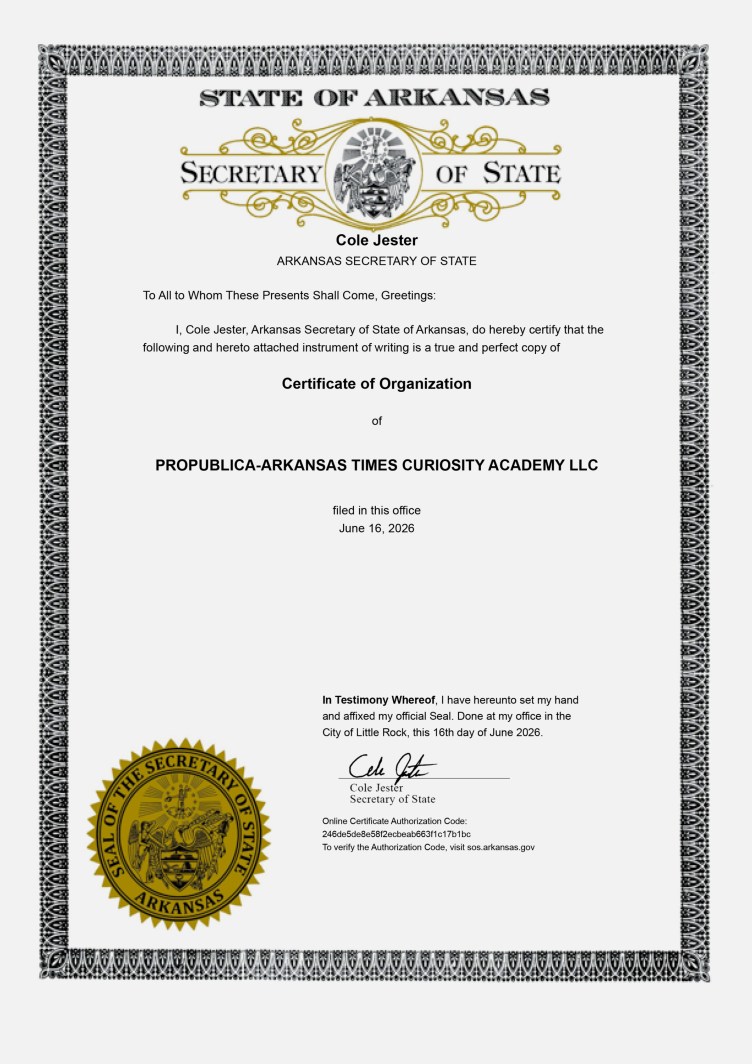
In Arkansas, West Virginia, and North Carolina, the team partnered with local newsrooms. These collaborations ensured better local understanding and provided necessary addresses for school applications. Applications featured names like Curiosity Academies, reflecting journalistic inquisitiveness.
Challenges and Findings
Filing paperwork varied by state. In Arkansas, establishing a private school was straightforward. No regulation from the Education Department was needed, just an online form, a $45 fee, and an American flag. However, accessing public funds was more complex, involving accreditation.
Microschools, however, had fewer requirements for public funding. This led the team to apply as a microschool. Although they missed the deadline for the current year, they could apply next year.
In West Virginia, registration required minimal information and a local partner provided a college transcript for qualification. Oversight of microschools was absent, as noted by a state education spokesperson.
In North Carolina, ethical considerations prevented completion due to the need for inspections specific to schools rather than the businesses used for applications.
Conclusion
Through this experiment, journalists found themselves inadvertently becoming school owners and administrators. To commemorate, they obtained ProPublicaAcademy.com and designed pencils as keepsakes, marking their brief stint in school establishment.
Readers are invited to ponder if they might establish a private school themselves through a quiz shared by ProPublica.