
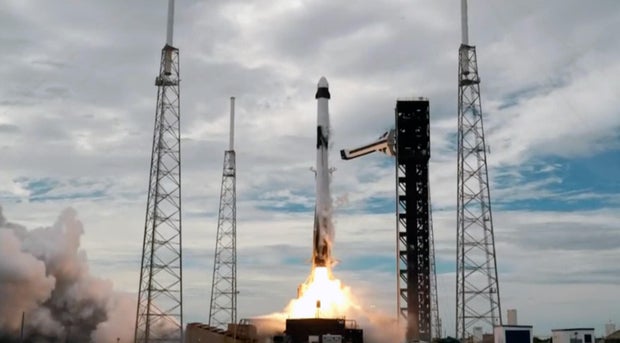
On a recent Thursday, a SpaceX Falcon 9 rocket embarked on a mission to the International Space Station, carrying a diverse crew consisting of two NASA astronauts, a Russian cosmonaut, and a Canadian astronaut. The launch, which involved the Crew Dragon capsule, took place at Cape Canaveral Space Force Station at 11:10 a.m. EDT.
Delayed Launch
This mission, designated as Crew 13, experienced a delay from its initial September schedule due to a valve replacement necessary in the Crew Dragon’s propulsion system. Jessica Watkins, commander of Crew 13, along with pilot Luke Delaney, Russian cosmonaut Sergey Teteryatnikov, and Canadian astronaut Joshua Kutryk, successfully lifted off from pad 40.
A Diverse Crew
Jessica Watkins, who holds a Ph.D. in geology and flew to space aboard a Crew Dragon in 2022, led a team of astronauts who were space rookies. This included Luke Delaney and Joshua Kutryk, both with backgrounds as military test pilots, and Sergey Teteryatnikov, who transitioned from the Russian submarine force to become a cosmonaut.
Personal Stories
Joshua Kutryk is anticipating the birth of his third child with his wife Heather, while engaged in the Crew 13 mission. This event positions the couple as the fourth in space exploration history to welcome a child while one parent is in space. Kutryk expressed his emotions through a heartfelt pre-launch message.
Canadian Involvement
Despite political frictions, including recent stances from President Trump, the Canadian Space Agency maintains its crucial role in collaboration with the U.S. space program. Kutryk is the latest in a line of Canadian astronauts contributing to this legacy, following the participation of Jeremy Hansen in NASA’s Artemis II mission.
Launch Technicalities
The Falcon 9 rocket, carrying the Crew Dragon capsule, followed a precise schedule, launching when Earth’s rotation aligned the pad with the space station’s orbit. The capsule’s trajectory is designed for quick docking, catching up with the ISS within eight hours for a seamless arrival at the Harmony module.
Mission Objectives
The Crew 13 members take on a busy schedule, with plans for station maintenance, spacewalks, and scientific research. Jessica Watkins expressed eagerness for the mission activities and valued the perspective of her fellow astronauts experiencing the processes for the first time.
Joining and Handover
They will join Crew 12 on the ISS, which includes international members from various space agencies, who will complete their 237-day mission by returning to Earth shortly.
Future Prospects
The arrival of Crew 13 clears space for a series of supply and equipment deliveries, critical for the continuation of scientific studies and station enhancements. Notably, these will include solar array installations that will be finalized with planned spacewalks, marking significant upgrades to the power systems on board.
Scientific Research
The mission’s principal aim is advancing scientific exploration in microgravity. Crew 13 will contribute to understanding diseases like heart disease and Parkinson’s, exploring crop production techniques for long-term space missions, and testing new medical diagnostic tools.
With numerous experiments and technology demonstrations planned, the mission anticipates an intensive schedule. Crew member Luke Delaney shared his enthusiasm for the upcoming work, highlighting the valuable contributions to science and the space program.