
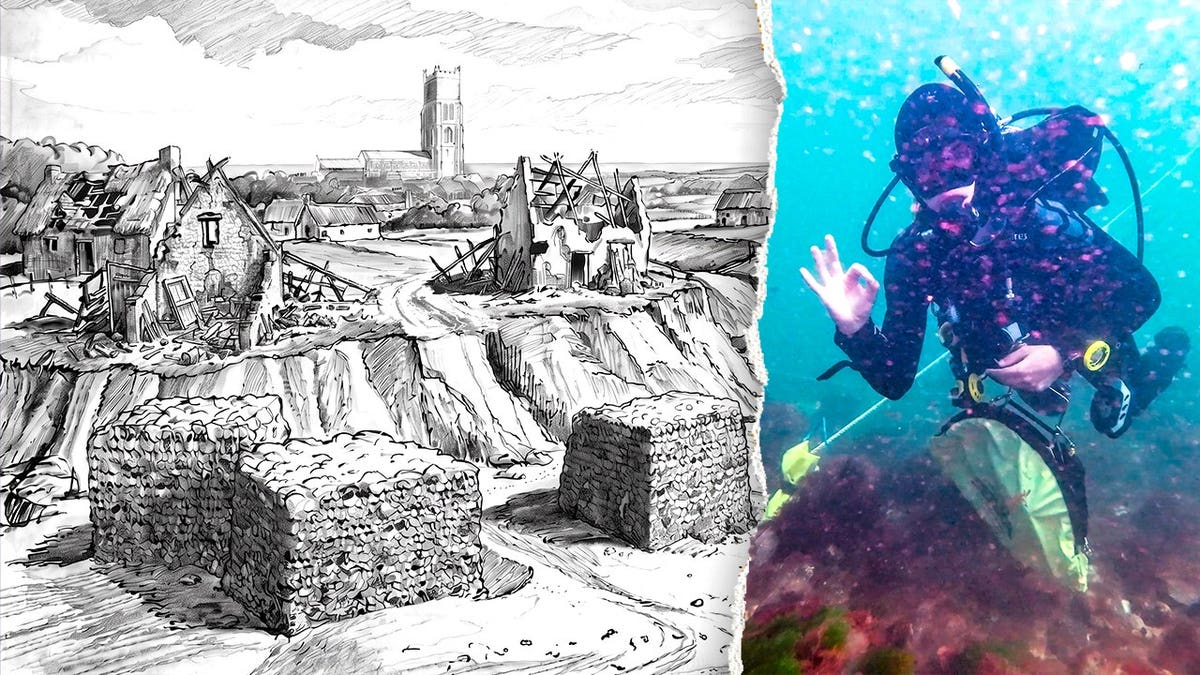
Divers have captured fascinating images of underwater structures that are believed to be remnants of an ancient village submerged by the sea 700 years ago. These visuals were recently documented off the coast of Norfolk, United Kingdom.
First Images of Shipden’s Remains
The remnants are thought to be of Shipden, a medieval settlement lost to the North Sea in the 14th century. The team of divers identified and mapped 25 man-made structures during their exploration. Massive stone features covered in marine life were documented beneath the seabed.
The images mark the first time these historic structures have been photographed.
The volunteer divers from the East Anglian branch of the British Sub-Aqua Club (BSAC) conducted this documentation as part of the Alfred Savin Project.
Previous Challenges and Unique Conditions
Despite the North Sea’s reputation for rough waters, conditions were unexpectedly calm during the summer dives. This allowed the team to carefully photograph and map the seabed features. The structures include flint—a commonly used medieval building material in Norfolk—and other cut stones, as well as stone foundation remnants known as caissons.
The caissons might have been efforts from the 14th century to protect the village from the sea, but their exact purpose is still uncertain.
Historical Context of Shipden
Shipden was noted in the Domesday Book, which recorded details across England following the Norman Conquest. In 1086, Shipden had a population of 117. It included three acres of meadow, a harbor, two churches, and woodland accommodated for supporting 36 pigs.
By the 14th century, Shipden’s name faded from records and the area became known as Cromer.
Ongoing Research and Speculation
Lead diver Nick Schiller shared that the team initially aimed to search for remains of the Victoria, a vessel that wrecked in 1888 on Church Rock. However, the exploration provided insights into Shipden and Cromer’s history.
“For the present, we’re putting forward ideas rather than conclusions,” Schiller said.
Peter Stibbons, chair of Friends of Cromer Museum and the project’s director, is reviewing medieval records in conjunction with these discoveries. While Church Rock was believed to be linked to St. Peter’s Church, findings now suggest it may relate to medieval sea defenses.
Stibbons remarked that locals have long known the legend of Church Rock, and new findings may challenge this long-held belief. His work underscores the need for continued investigation to better understand these submerged mysteries.