
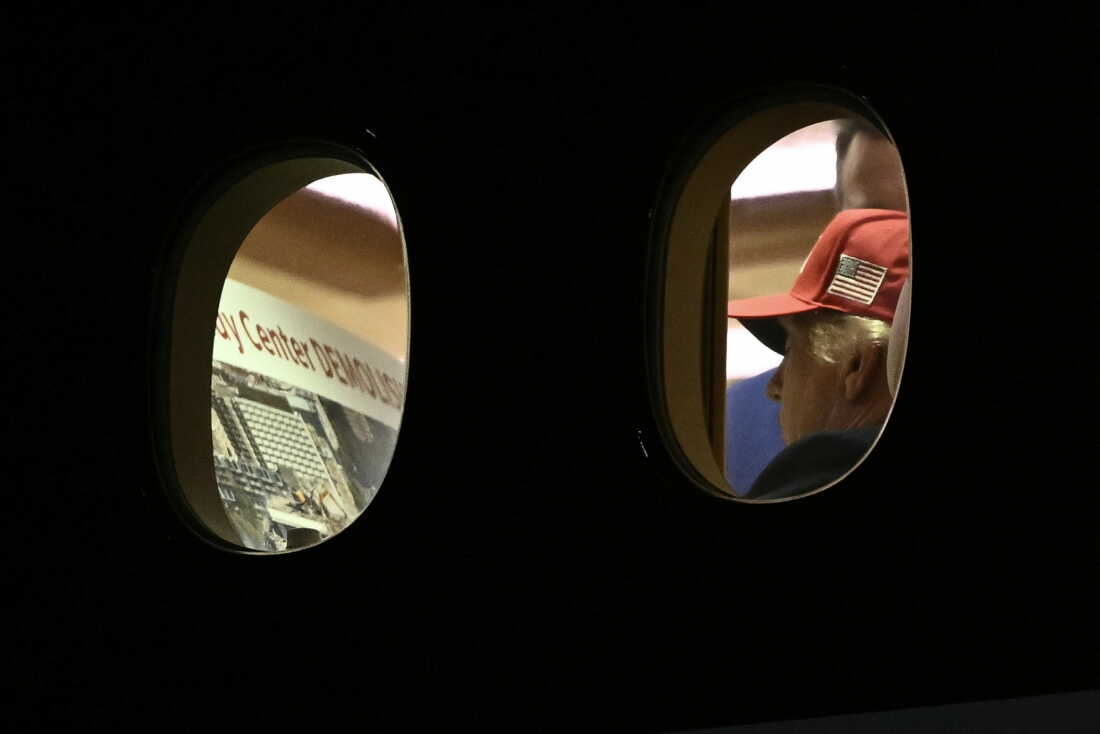
President Donald Trump was photographed aboard Air Force One examining a Kennedy Center printout after landing in Maryland, as captured by Brendan Smialowski/AFP via Getty Images.
A federal judge ruled that President Trump cannot demolish the Kennedy Center without a 30-day notice. This decision followed Trump’s recent threat to demolish the arts center. The situation has left the center’s future uncertain due to numerous legal actions this week.
The Kennedy Center’s board of directors had previously voted to close the center, citing financial and physical concerns. Court documents were filed by both the board and its critics. Trump warned that the complex might be demolished if his name does not grace its main building, claiming his administration deserves recognition for any involvement or fundraising efforts. However, Trump provided no evidence for his claim that the center has lost “hundreds of millions” of dollars, further comparing it to New York’s Carnegie Hall.
U.S. District Judge Christopher Cooper required the board to give a 30-day notice before any demolition or construction. His ruling was in response to a lawsuit filed by U.S. Rep. Joyce Beatty, who objected to placing Trump’s name on the building. Beatty later sought an emergency hearing but Cooper denied it, opting for the notification requirement instead.
Statements in court showed Trump reviewing images appearing to show him with a placard reading “Kennedy Center DEMOLISHED.” While the authenticity of these images is unconfirmed, they made their way into federal court documents.
Judge Cooper directed the Kennedy Center to inform both Plaintiffs and the Court of any changes to the board’s plans that might alter the decision to refrain from demolition or new construction. A detailed status report is expected from the board by Wednesday.
Recent issues include a sworn court statement from Washington Litigation Group. A staff member reported witnessing a forklift damaging building pillars while construction crews erected gates around the Kennedy Center. The center’s executive director, Matt Floca, stated the closure is temporary due to public safety hazards.
Cooper is presiding over a related lawsuit filed by several architecture and culture groups. He stipulated that notifications of construction or demolition must be sent to these groups, Beatty, and the court.
The architecture organizations, including The American Institute of Architects (AIA) and the National Trust for Historic Preservation, requested Cooper appoint an independent party to safeguard the building and its institution. They argue that Trump and the Kennedy Center board are neglecting their duties regarding the arts institution, acting as a memorial to President John F. Kennedy.
The groups emphasized legal and ethical responsibilities accompanying trustee positions in a statement sent to NPR. They stated, “With those positions come legal and ethical responsibilities… A trustee cannot sit still while the institution fails. Nor can a trustee withhold the exercise of fiduciary responsibilities to obtain a personal honor.”