
Experts caution that China is eroding America’s global leadership using artificial intelligence without firing a shot. They highlighted a covert strategy involving three key tactics: extracting logic from U.S. models, undermining U.S. developers with free open-source software, and weaponizing those systems for cognitive warfare.
China is replicating billions of dollars in U.S. research through labs that analyze state-of-the-art American AI and mimic its functions. They concurrently inundate the global market with free alternatives. Leah Siskind, AI research fellow with the Foundation for Defense of Democracies, described this as a ‘multi-front war.’ She noted that America wins in some areas but loses in others.
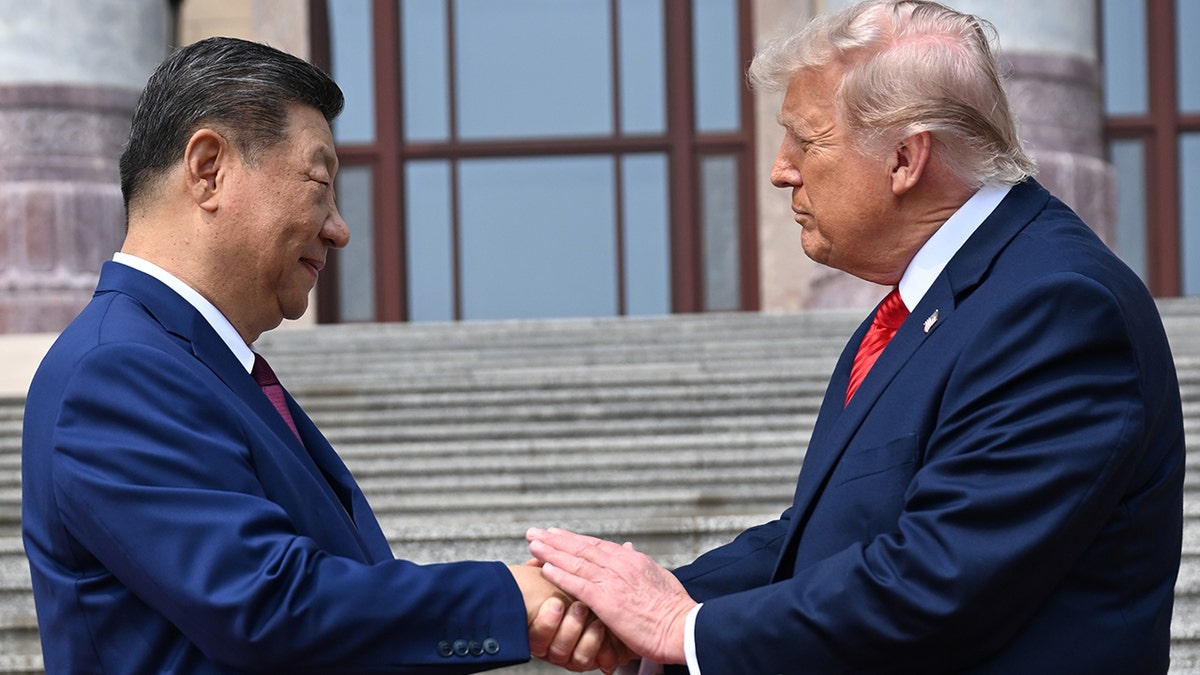
Chinese President Xi Jinping arrives in the U.S., prompting experts to urge urgency in addressing these non-cinematic threats with seriousness akin to military posturing.
Siskind pointed out China’s focus on disseminating open-source models globally, while U.S. firms invest heavily in costly proprietary systems. The high expense of American tech means that several Fortune 500 companies opt for Chinese models, risking potential censorship and hidden vulnerabilities.
China’s tactic mirrors its earlier approach with solar panels, aiming to overshadow American models by offering cost-effective, widely available alternatives. Gordon Chang warns that Beijing could potentially dominate global AI as it once did with solar panels.
Chang emphasized the threat of AI-enhanced propaganda on U.S. decision-making and democratical sovereignty.
Despite the U.S. boasting superior infrastructure with thousands of data centers and advanced microchips, China narrows the gap using ‘knowledge distillation’. This involves smaller models analyzing larger American models to duplicate their intelligence, exemplified by the Chinese DeepSeek model released in 2025.
A joint advisory from the Department of Homeland Security recently highlighted Chinese ‘knowledge distillation campaigns’ stealing from U.S. models.
Furthermore, the deployment of embodied AI into infrastructure like factory automation and autonomous supply chains poses a direct threat to U.S. interests. Cognitive warfare, enhanced by AI, could affect critical national security decisions.
Siskind advises tightening chip export loopholes, blacklisting deceptive labs, and fostering U.S. open-source development. This ensures advanced systems support democratic rather than authoritarian values.
Chang connects these technological defenses to broader implications involving China’s imperial-era ‘Tianxia’ notion, suggesting that a Chinese regime bolstered by AI might wield unprecedented global influence.
As President Donald Trump addresses the United Nations General Assembly, he emphasized outperforming China, referring to AI as ‘superintelligence’. He reaffirmed America’s intent to lead in AI innovations.