
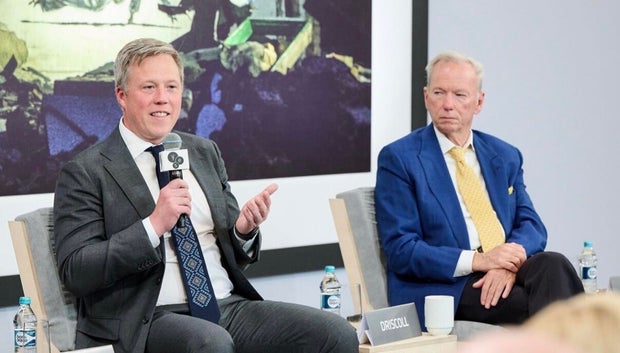
In his first public appearance since leaving the Trump administration, Dan Driscoll, former Secretary of the Army, delivered a warning about an “inflection point in warfare.” He argued that the world’s largest militaries are not keeping pace with necessary speed and innovation.
Driscoll, adorned with a tie featuring a traditional Ukrainian pattern, appeared alongside Eric Schmidt, former Google CEO and current head of Perennial Autonomy, a U.S. defense firm active in Ukraine. The discussion, moderated by CNN’s Fareed Zakaria, was part of the Yalta European Strategy forum. This annual conference, organized by the Victor Pinchuk Foundation, focuses on Ukraine’s future within the West’s security framework.
Both Driscoll and Schmidt lauded Kyiv’s wartime technological advancements, specifically highlighting “DELTA,” a Ukrainian software platform. This platform integrates data from radars, sensors, and soldiers to present a comprehensive battlefield overview. Driscoll emphasized that the technology surpasses any currently owned by the U.S. military.
Driscoll noted Ukraine’s acquisition of processing power and expansion of AI capabilities offers a significant advantage. He asserted, “It provides an amazing opportunity for your nation to outrun the Russians, out-innovate, and out-partner to crush them.”
Driscoll’s remarks at the conference marked his first public appearance after resigning from his former position. The announcement of his resignation on August 31 highlighted contentious disagreements with Defense Secretary Pete Hegseth over senior officer removals and modernization efforts within the Army.
During his tenure, Driscoll pushed for procurement reforms, leading to more rapid weapon deployment to U.S. soldiers. This urgency was underscored by the war with Iran. Upon recognizing insufficient U.S. defenses against Iranian Shahed drones, Schmidt’s Perennial Autonomy provided swift assistance by supplying thousands of interceptor and reconnaissance drones, now widely used in Ukraine.
Though Driscoll and Schmidt emphasized strategic improvements, the recently discontinued drone battalion raises questions about U.S. commitment to learning from Ukraine’s drone warfare.
Among the forum attendees, there was robust interest in these innovations. Fareed Zakaria commented on the stark difference between the number of drones the U.S. plans to buy and Ukraine’s production projection. Former CIA Director David Petraeus corrected Zakaria, indicating Ukraine aims for even higher production figures.
Despite recent shifts away from lessons learned in Ukraine, Driscoll defended the administration’s commitment to Kyiv. He acknowledged potential discrepancies between U.S. support and Kyiv’s expectations, yet reaffirmed unwavering support.
Driscoll stated that his greatest impact now lies outside government. He remarked, “My highest and best use to make the world a little bit safer at this very scary time is to do it on the outside.”