
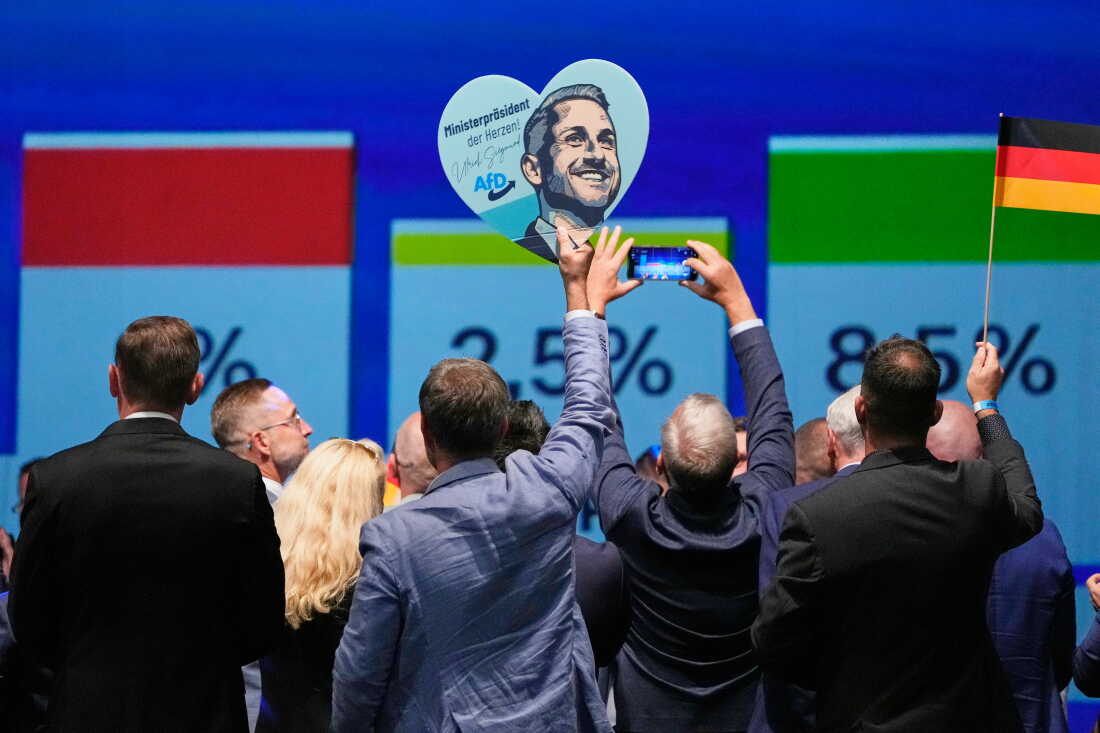
In Magdeburg, Germany, supporters of the Alternative for Germany (AfD) celebrated their party’s impressive performance in the Saxony-Anhalt state election. With a sign featuring top candidate Ulrich Siegmund, the crowd marked what was a pivotal moment in German politics.
AfD’s Historic Performance
The AfD, a populist far-right party, declared victory after more than doubling its share of the vote in the state’s election. They secured 43.8% of the votes, their strongest result in a German state election. This performance brings them close to wielding power in the region for the first time since Nazi Germany’s era.
The Christian Democratic Union (CDU) witnessed a significant drop, with their share of the vote halved to 17.2%, setting a historic low. Other parties also saw declines; the SPD obtained 9.3%, the Greens 8.9%, and Die Linke 8.6%. Each of these parties has ruled out forming a coalition with the AfD.
The AfD could potentially join forces with the BSW, an anti-immigration, left-wing populist party that garnered 5.3% of the votes. Such a coalition would strengthen the AfD’s position in Saxony-Anhalt’s parliament.
Statements from Political Figures
AfD’s Ulrich Siegmund stated, “This result sends a very clear signal to Berlin. People want their old, secure Germany back.” His remarks highlight the party’s agenda to push for a more conservative and nationalist direction.
From the CDU, candidate Sven Schulze acknowledged the AfD’s victory and expressed uncertainty about coalition prospects. He mentioned forming a “firewall” coalition would mean working with Die Linke, a scenario the conservatives reject.
National and International Reactions
Alice Weidel, AfD’s federal co-chair, delivered a statement predicting the CDU’s declining future in elections, highlighting the AfD’s surge nationwide. She credited Siegmund’s vibrant campaigning methods, which included engaging slogans and active social media presence on platforms like TikTok.
The AfD’s extremist classification by Germany’s intelligence remains a concern. Their radical proposals include a “remigration” policy aimed at extensive deportations, even targeting Ukrainian refugees without employment. Educational reforms featuring segregated schooling and altered historical teachings are also on their agenda.
International figures also reacted to the election results. Former President Trump shared his approval on Truth Social, echoed by Russian envoy Kirill Dmitriev, praising the result as “historic.” In contrast, Polish Prime Minister Donald Tusk criticized those celebrating the outcome as “idiots or traitors.” French Europe Minister Benjamin Haddad expressed alarm, labeling it a “grave moment in Europe.”
Adding to the discourse, Tesla CEO Elon Musk commended the AfD’s win. Siegmund acknowledged Musk’s support, emphasizing its importance for the party’s ideology.