
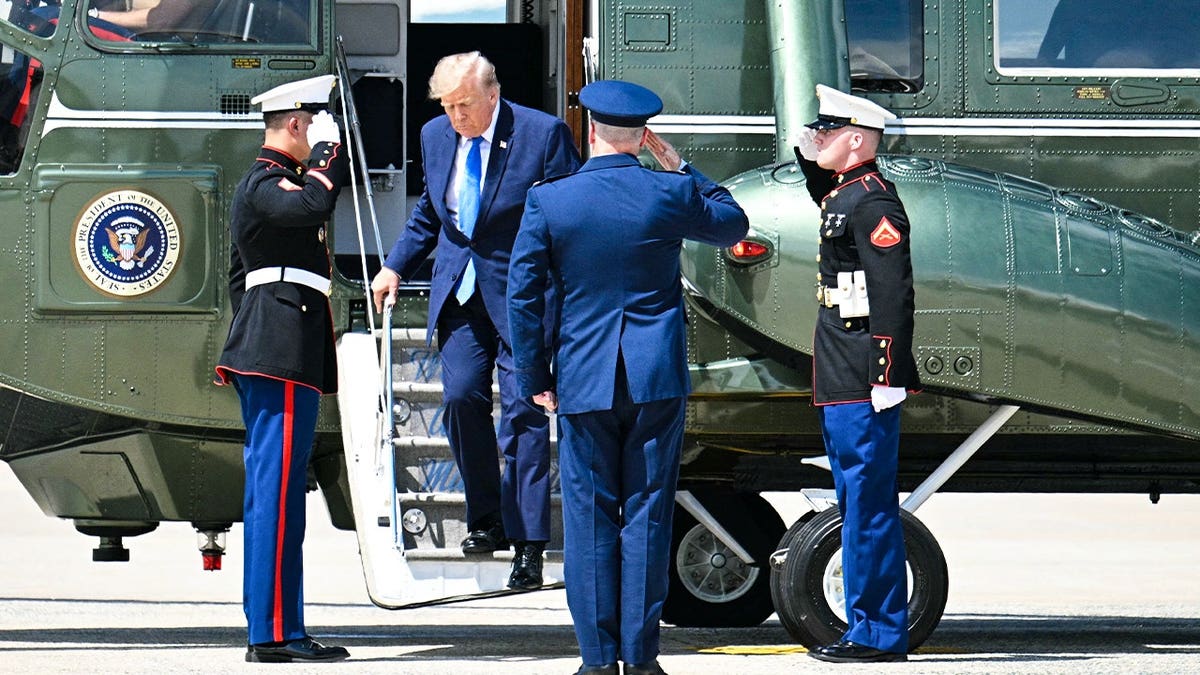
The crew of Marine One attempted several times to alert Reagan National Airport about President Donald Trump’s helicopter departure on August 4, before flying near a commercial jet. A preliminary report from the National Transportation Safety Board (NTSB) highlights issues in these failed communications.
Failed Communications
The crew’s initial call to Reagan National’s helicopter-control frequency went unheard, while a follow-up transmission was unclear. Despite trying to relay a three-minute notification through Joint Base Anacostia-Bolling’s helicopter facility, no connection was established, according to the report.
Air Traffic Incident
“TRUMP EYES NEW WHITE HOUSE LAWN PROJECT …”
As Marine One lifted off from the White House for Los Angeles, Envoy Air Flight 3742 began its ascent from Runway 1 toward Pensacola, Florida. During this time, they came considerably close, measured laterally within about 0.82 nautical miles, and 700 feet vertically, as the Federal Aviation Administration (FAA) estimated.
FAA Investigation
The Envoy flight crew noted their traffic-collision system alerted them by announcing “Traffic, Traffic” yet failed to give a resolution advisory requiring action. Marine One later reached the tower upon gaining sufficient height to maintain reliable communications, receive a traffic advisory, and acknowledge seeing the Envoy jet.
On July 30, a communications concern arose during discussions with Marine Helicopter Squadron One (HMX-1) and tower staff at Reagan National. They agreed on using alternate backup methods should direct radio communications fail, a tactic attempted on August 4.
Technical Adjustments
FAA technicians found inadequate coverage between the radio transmitter-receiver site and the Ellipse, where Marine One temporarily operated amid White House construction. Consequently, the radios for the helicopter-control frequency were relocated to Reagan National’s control tower. Tests reported no deficiencies post-relocation.
A joint review by the FAA and NTSB characterizes the event as a “momentary loss of separation,” according to preliminary safety information. Rather than coming closer than 1.5 nautical miles horizontally, a vertical gap of 700 feet met the FAA standards applicable for Class B airspace.
Ongoing Review
The NTSB continues analyzing surveillance data to verify the minimal separation between Marine One and the commercial aircraft. The White House affirmed President Trump faced no danger, stating, “Marine One flights are piloted by some of the best aviators in the world.” The NTSB’s preliminary report does not speculate on findings or probable cause and will continue with public safety recommendations and releases via a public docket and final report process.
For detailed information, Fox News Digital’s Robert McGreevy and Stepheny Price contributed to the report.