
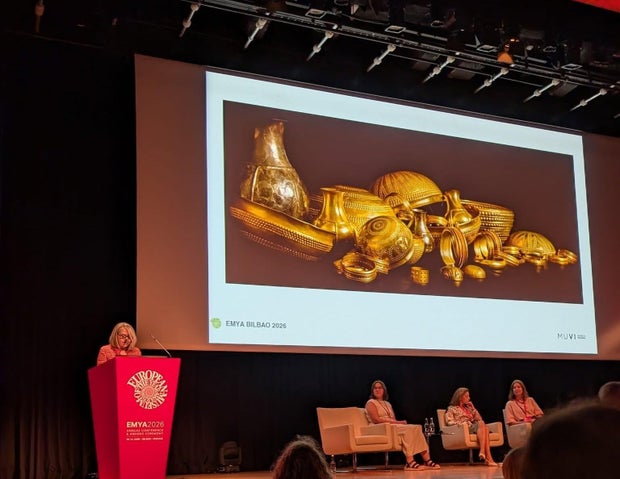
On a Thursday morning, thieves executed a swift raid at the Treasure of Villena, one of the major Bronze Age gold collections in Europe. The museum raid occurred in the Spanish town of Villena and lasted only minutes. The alarm at the Villena Museum triggered around 5:20 a.m.; by 5:24 a.m., the thieves had exited the building.
The operation was described as ‘super-fast and super-professional’ by a spokesperson for the town council. Villena’s mayor, Fulgencio Cerdan, expressed his devastation, noting the personal impact on the community. ‘For those of us from Villena, this destroys us. It’s part of our heritage, of our wealth,’ he said, visibly shaken.
The stolen collection included 29 bracelets, 11 bowls, three bottles, and other gold objects. Although primarily gold, the treasure also contained silver, iron, and amber pieces, all dating back to around 1,000 BC. Originally discovered in 1963 by Jose Maria Soler, the treasure was found in a vessel within a dried-out riverbed in Villena. While the historical value is immense, the gold’s estimated worth is about $2 million.
Officials report that the thieves arrived in multiple vehicles and gained entrance through a window. According to Manuel Pineda, the Spanish government’s deputy representative in Alicante, all security systems were operational. The museum’s spokesperson confirmed this, emphasizing ‘no failure’ on the museum’s part. An earlier alarm at the city’s sports center is currently under investigation for its possible role as a diversion tactic by the thieves.
This heist adds to a string of similar daring thefts across European museums. In October of the previous year, thieves struck the Louvre in Paris, escaping with jewelry valued at $102 million in under eight minutes. Though arrests were made, most of the jewels remain missing, except for a dropped crown.
Other recent thefts include the burglary of paintings by Renoir, Cezanne, and Matisse from the Magnani-Rocca Foundation in Italy, as well as other valuable works from museums in Sicily and Limoges.