
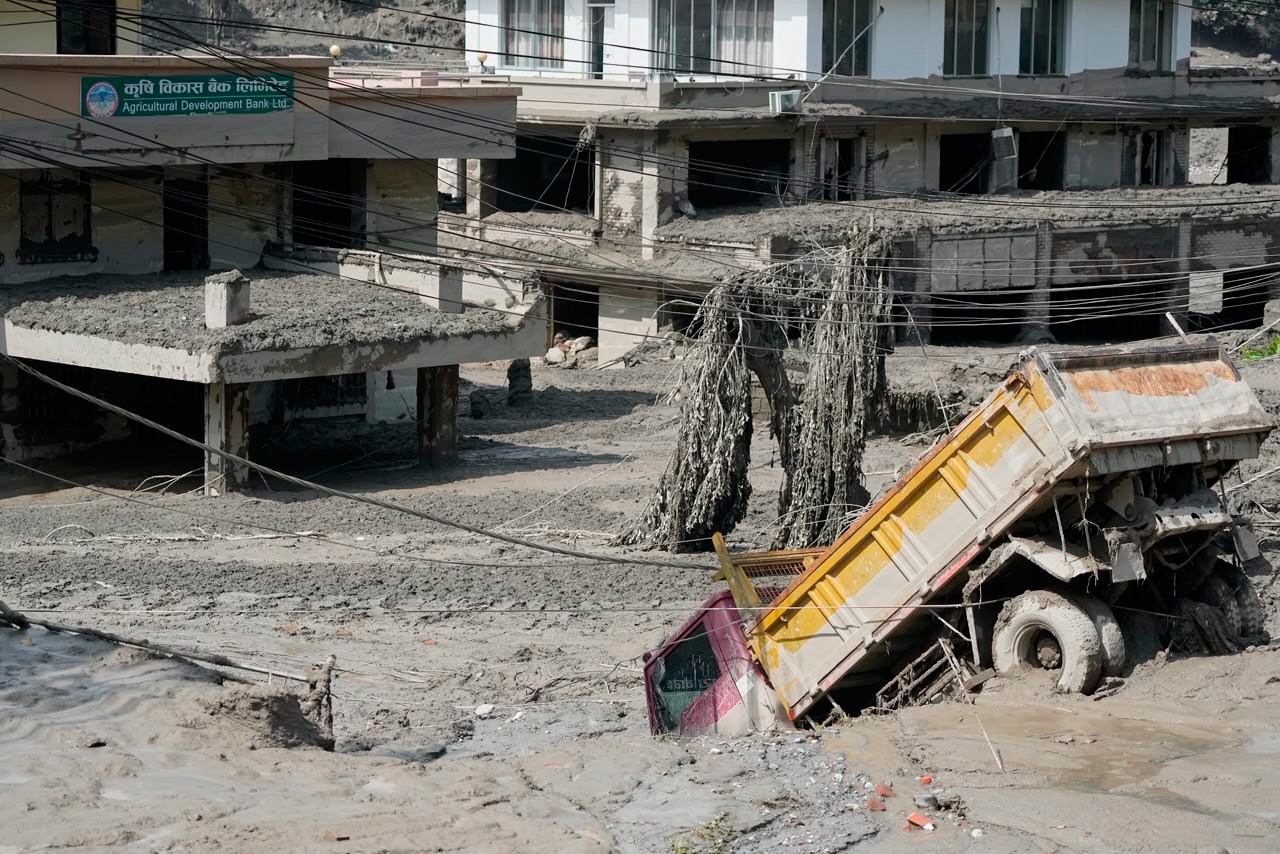
On Wednesday, a massive surge of muddy water swept through the Gyirong Port at the Himalayan border, causing widespread destruction as flash floods ravaged northern Nepal and Tibet. Surveillance footage captured at the Resuo Bridge shows people fleeing as a torrent of mud, rock, and water cascaded down from the Nepalese side, engulfing buildings at the port.
The disaster claimed at least eight lives, and hundreds remain missing after an avalanche of ice and rock blocked a river, unleashing a flood. The Associated Press reports that villages, roads, and hydropower projects were destroyed in Nepal’s Rasuwa district before the flooding reached the Chinese border, disrupting power and communications.
Approximately 384 tourists are reported missing, including 291 foreign nationals from nations such as India, the United States, the United Kingdom, and Malaysia. Newsweek has sought comments from the U.S. embassy in Nepal and the U.S. State Department.
Nepal has appealed to neighboring India and China for assistance in rescue efforts. Sasmit Pokharel, a spokesperson for the Nepalese government, confirmed the request, highlighting the urgency of the situation.
Flash Flood Triggers
The flash flood was triggered by an ice-rock avalanche from a glacier on the Nepalese side, which likely obstructed the Lhende Khola River before unleashing a downstream surge. According to the International Centre for Integrated Mountain Development, the river has flooded twice in 14 months, driven by climate-related factors.
Saswata Sanyal, a disaster risk reduction specialist, emphasized the need for early warning systems given the Himalaya’s vulnerability to climate hazards. The region is warming faster than the global average, making it particularly prone to climate-related disasters. Research indicates that glacier ice loss across the Hindu Kush Himalaya has doubled since 2000 due to rising temperatures.
China’s Response
Chinese President Xi Jinping has directed extensive efforts to locate missing individuals following the mudslide at Gyirong Port. He emphasized evacuation of residents at risk, timely medical treatment for the injured, and strengthening monitoring systems.
Premier Li Qiang instructed verification of missing and affected individuals and ordered coordination with other countries for information sharing. Vice Premier Zhang Guoqing visited the affected area to lead rescue operations.
The Xigaze detachment of the People’s Armed Police, consisting of 145 officers, has been deployed to Gyirong Port. Drone footage reveals the extensive damage and debris accumulation at the site. China’s Ministry of Finance and Ministry of Emergency Management allocated roughly $17.9 million for rescue and relief efforts, showcasing the scale of response.
This article includes reporting by The Associated Press.