
The change of seasons brings with it early sunsets and crisper mornings. As autumn approaches, both the Old Farmer’s Almanac and the Farmers’ Almanac reveal their forecasts. These publications, though separate, offer weather predictions alongside gardening and skywatching advice.
Fall and Winter Predictions
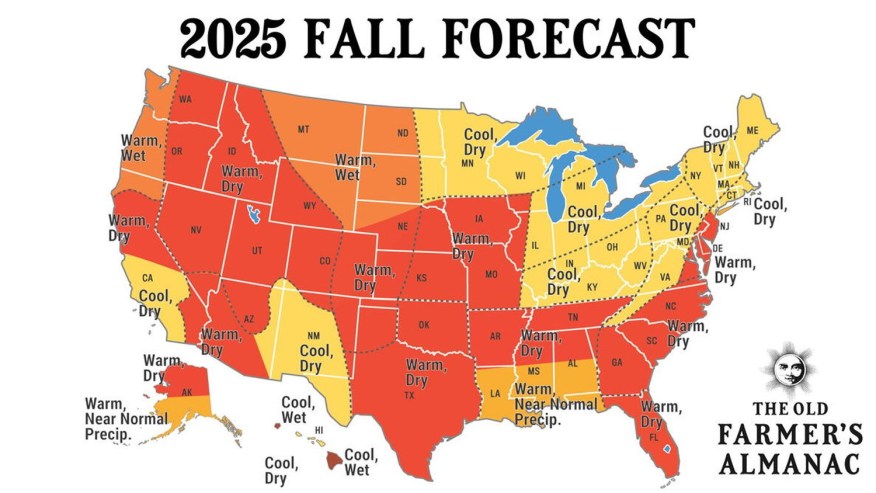
The Old Farmer’s Almanac forecasts a “warmer than average” fall, especially in the Pacific Northwest and northern New England. The Plains and Rocky Mountains might see a warm, dry season, while the Midwest, Ohio Valley, and East Coast could have a cool, dry fall. This outlook closely resembles last year’s predictions.
Looking to winter, the Farmers’ Almanac suggests “snow, sleet, and surprises” are in store for much of the U.S. The upper Plains and Midwest might be snowy, while the Gulf and southern East Coast could experience wetter conditions. New England might brace for coastal storms. These predictions show some variation from last year’s expectations.
Forecast Accuracy
Meteorologist Rich Segal, formerly of Nexstar’s KXAN, notes that belief in these forecasts varies. Both almanacs claim about 80% accuracy, although studies suggest the Farmers’ Almanac is only correct half the time.
The Old Farmer’s Almanac bases its formula on solar science, climatology, and meteorology, analyzing solar patterns and historical weather with current activity. The Farmers’ Almanac, evolving since 1818, considers the moon’s influence and compares past and current weather.
Both publications engage in long-range planning, which can lead to skepticism. Segal mentions that forecasts might fail within 24 hours, highlighting the unpredictability of weather that far out. For example, the National Weather Service issues its winter forecast only by mid-October, indicating its complexity and vulnerability to change.
Comparing Techniques and Factors
The almanacs and NOAA, which uses probabilities for predictions, sometimes consider similar elements. A potentially strong El Niño, projected at over 90% certainty, may influence weather. Typically, El Niño brings warmer, drier conditions to the northern U.S. and wetter winters to the south.
Despite varied methods, whether to trust almanac predictions remains a personal choice. Segal suggests the almanacs hold value for believers. Sandi Duncan of the Farmers’ Almanac acknowledges that, despite aiming for accuracy, nature remains unpredictable.
Both almanacs and NOAA provide insights, but it’s essential to approach weather predictions with an understanding of their inherent uncertainties.