
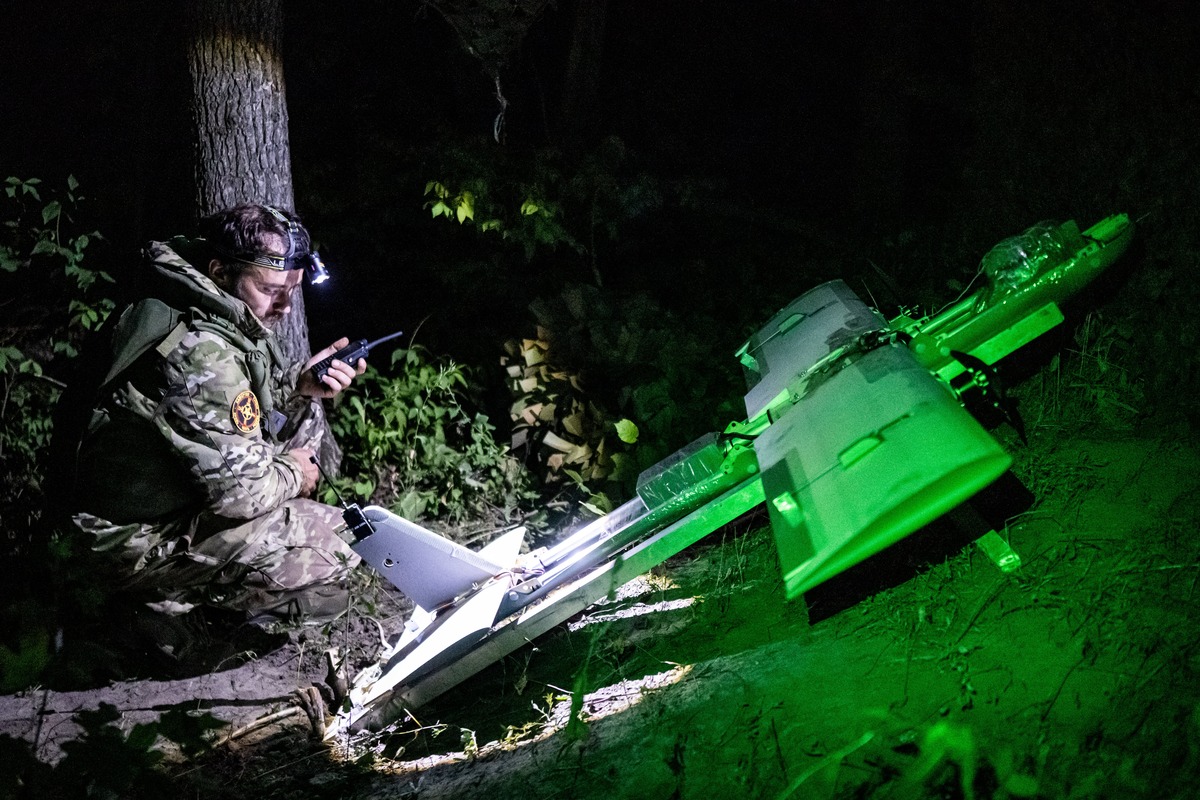
Russia’s Drone Launch Sites
A recent report reveals that Russia has established at least ten secret locations equipped to launch long-range drones into NATO territory. This follows warnings from alliance officials about the potential for Moscow to launch a limited attack on NATO soil soon. According to a Sunday report by The Telegraph, Russia has constructed numerous new ‘launch rails’ at bases near Belarus and Ukraine. These are intended for launching fixed-wing drones for missions or attacks.
The intelligence firm DroneSec, through satellite imagery analysis, indicated that at least twenty of these new launch rails could fire Russia’s advanced long-range attack drones. Many of the ten sites, situated in remote areas or integrated with military bases and airports, have recently targeted Kyiv, the Ukrainian capital.
Despite these developments, Russia denies any intention to attack NATO territory, dismissing such claims as ‘nonsense.’ Newsweek has sought comments from the Russian Defense Ministry.
The Evolution of Drone Warfare
The ongoing conflict in Ukraine has significantly transformed drone warfare, as Kyiv and Moscow vie for drone superiority. This competition captures the close attention of NATO countries. Russia is reputed for deploying Iranian-designed Shahed drones, including its domestically produced variant, the Geran-2. Ukrainian intelligence suggests the Russian government is hastening to create jet-powered variants capable of reaching more distant targets. Currently, Russian production facilities yield about 3,000 upgraded Geran-4 and Geran-5 attack drones monthly.
Most of these advanced drones are produced in a plant in Yelabuga, located in Russia’s Tatarstan region, where a drone hub is established. Sources from Russia and Ukraine indicate the Geran-5 can travel approximately 1,000 kilometers, or over 600 miles. This range allows targets hundreds of miles from NATO’s eastern edge to be within reach when launched from Russian territory near Ukraine or Belarus.
This launch site expansion shows how Russia has expanded its ability to launch greater numbers of drones while at the same time using technology to make the types of drones used more difficult to intercept,said DroneSec CEO Mike Monnik.
Since Russia’s full-scale Ukraine invasion in February 2022, drones and missiles have often violated NATO airspace, causing fighter jets in bordering countries to scramble and sometimes shoot down these unmanned vehicles.
In September 2025, NATO officials accused Russia of testing the alliance’s response when at least twenty drones crossed into Poland. Concerns escalated when a Russian cruise missile crashed in eastern Poland near Ukraine’s border.
Russia’s Hybrid Approach with NATO
The current airspace violations come at a delicate period for Europe. Discussions arise concerning the U.S. commitment to Europe’s defense. U.S. President Donald Trump and his administration have criticized European countries for their low defense budgets and reliance on the U.S. military presence.
General Carsten Breuer, Germany’s highest-ranking military officer, suggested Moscow uses drones to assess NATO’s air defense reactions. ‘Hybrid attacks are occurring daily in NATO countries,’ he informed The Wall Street Journal.
A ‘hybrid attack’ encompasses actions short of open warfare, such as cyberattacks, information campaigns, or targeting infrastructure. Although NATO believes Russia has long engaged in hybrid warfare with the alliance, a large-scale attack is unlikely. It is expected Russia might execute smaller military operations against a Baltic state or Poland to gauge NATO’s response or heighten its hybrid assaults.
A recent U.S. intelligence analysis reported by The Wall Street Journal suggests the Kremlin could attempt to seize part of NATO territory or intensify hybrid attacks against the alliance as soon as this year.
Meanwhile, NATO countries continue to practice responses to various Russian threats, including military movements into a Baltic state.