
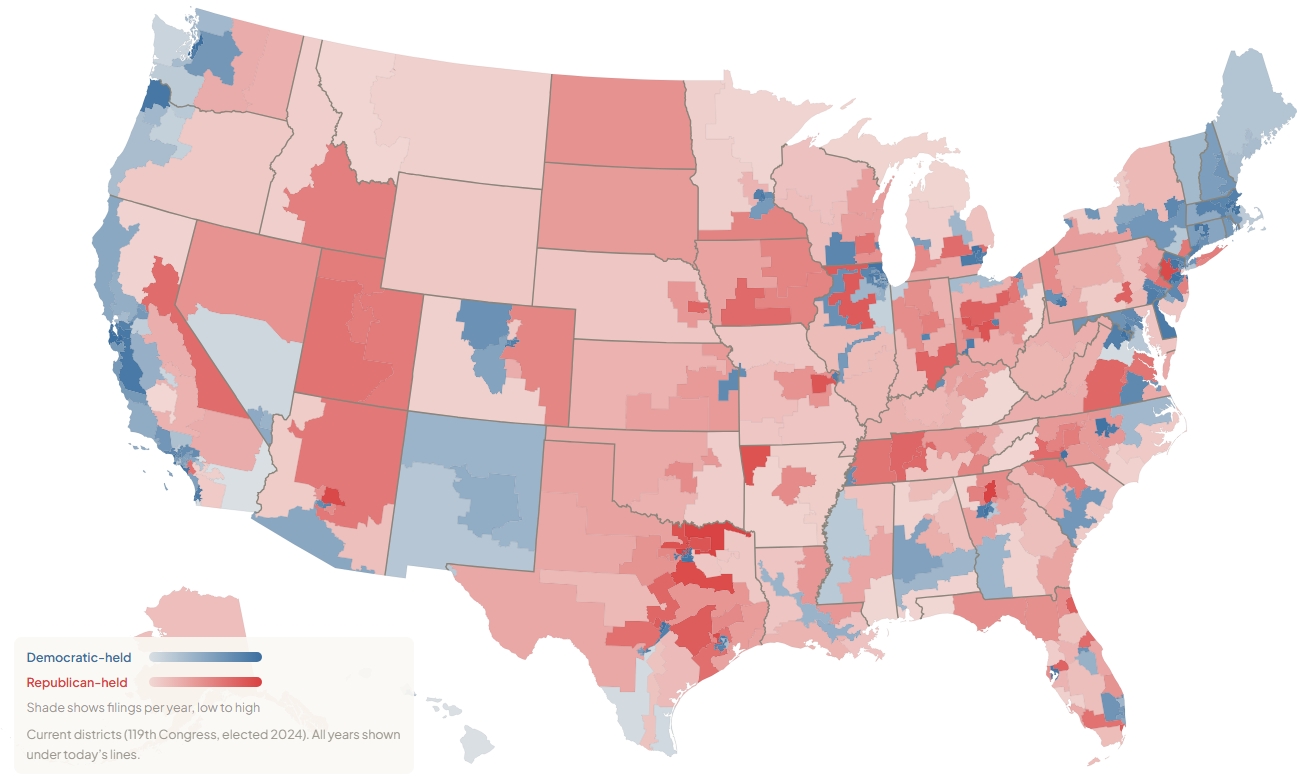
Recent analysis of federal labor data by LayoffHedge shows that congressional districts represented by Democrats have filed over three times as many certified H-1B labor applications as those held by Republicans in the past decade. The study mapped approximately 6.9 million certified Labor Condition Applications (LCAs) to current congressional districts. Democratic districts accounted for 5.17 million filings between fiscal 2015 and the second quarter of fiscal 2026, while Republican-held districts had 1.69 million. Four vacant districts accounted for the remaining 56,596 filings.
Although Democratic districts led overall, recent growth trends differed. The eight districts with the fastest growth in H-1B filings from fiscal 2019 to fiscal 2025 were represented by Republicans in Texas.
The figures track LCAs, not visas or individual workers. Applications can include requests for multiple workers or instances of a worker associated with multiple filings, such as extensions or employer changes.
A LayoffHedge spokesperson clarified that the data shows the intended work locations requested by employers, without attributing causation to political parties. The Trump administration has moved to impose stricter regulations on legal immigration pathways, including the H-1B program. New measures include replacing the H-1B lottery with a system favoring higher-paid workers and expanding biometric screening fees to certain H-1B extension requests. A proposal to institute a $100,000 fee on specific new petitions was blocked by a federal court.
Divergent views persist regarding the H-1B program. Restrictionists argue it often replaces American workers. Conversely, supporters, including tech executives, claim access to skilled foreign workers is vital for U.S. competitiveness.
The spokesperson noted that national debate obscures where work is actually performed. Every certified filing includes a work site address, mapped to the relevant congressional district.
The highest concentrations of filings appeared in Democratic-held districts linked to major tech centers. California’s 17th District, led by Rep. Ro Khanna, had 323,966 filings. New York’s 12th District, represented by Rep. Jerrold Nadler, had 259,001 filings, and California’s 16th District, under Rep. Sam Liccardo, followed with 233,165.
The leading Republican-held district, Texas’ 4th, led by Pat Fallon, recorded 106,892 filings. Georgia’s 7th District, under Richard McCormick, had 96,705, and Texas’ 24th, led by Beth Van Duyne, had 81,784.
Combined, the top 10 districts recorded 1,727,766 filings, marginally more than the 1,694,909 associated with all 219 Republican districts. The Democratic total includes 38,814 filings from the District of Columbia’s at-large district, represented by nonvoting Delegate Eleanor Holmes Norton.
The vacant districts as of August 6 include California’s 14th, Florida’s 20th, Georgia’s 13th, and Texas’ 23rd. The House Clerk’s Office lists special elections for California and Georgia later in August.
It’s important to note that all data aligns with current district boundaries and parties, not necessarily reflecting the party in office during each filing. LayoffHedge utilized work site ZIP codes and Census geographic data for district assignment, achieving a 99.5 percent match rate. According to their analysis, 40 districts accounted for half of all mapped filings, with major concentrations in Democratic districts.