
Russian President Vladimir Putin expressed concern on Wednesday about NATO’s plans to introduce new weapons in the Pacific, suggesting these moves pose a “threat to Russia”. According to state media, Putin noted a growing potential for conflict, highlighting NATO’s increasing presence in the region.
While it’s unclear which specific weapons systems Putin referenced, the United States, NATO’s most influential member, has redirected its focus toward the Indo-Pacific amid China’s expanding military capabilities. In late March, the U.S. permanently stationed advanced F-35 fighter jets in northern Japan. These jets can deploy some of the most advanced weapons in the U.S. arsenal. Additionally, in May, the U.S. test-fired a long-range missile from a Typhon system in the Philippines. Known as the Mid-Range Capability, the Typhon system can fire Tomahawk cruise missiles with a range of roughly 1,000 miles, as well as the U.S.’s SM-6 missile with a shorter range.
This year, various NATO member countries have contributed ships, planes, and troops for rotations in the Pacific. Italy, for instance, dispatched a ship specializing in air defense to the area in early May. Furthermore, thirty nations, including several NATO members, conducted joint exercises with the U.S. Pacific Fleet until July’s end.
Despite past tensions with former President Donald Trump’s administration, the rising threat from North Korea’s nuclear and missile programs, coupled with its increasing alignment with Russia, has prompted U.S. allies like Japan and South Korea to heighten their military spending while maintaining their alliance with the U.S.
Putin remarked on Wednesday that “new weapons systems, capable of threatening our country, are being deployed and planned here.” However, a NATO spokesperson emphasized that the alliance remains purely defensive, posing “no—zero—threat to Russia.”
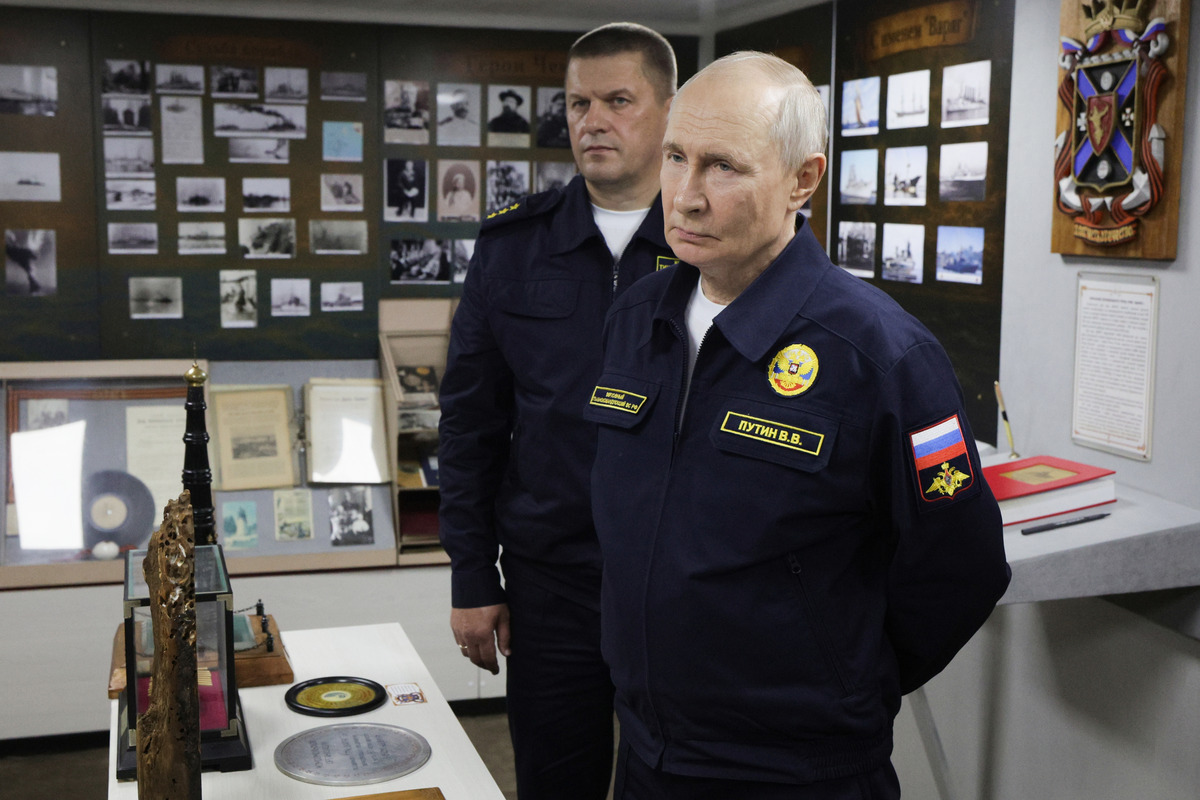
While observing Russian Pacific Fleet drills near Yuzhno-Sakhalinsk, Putin’s remarks were particularly significant. The area is in proximity to Japan, highlighting regional tensions. Recent reports reveal Russia has enhanced security measures at its Rybachiy submarine base, the main hub for the Pacific Fleet located on Kamchatka Peninsula. Anti-drone nets now protect many of Russia’s submarines at this site. These measures indicate Russian officials’ concerns about potential threats to their advanced submarine fleet.
Approximately 4,600 miles from Ukraine, the likelihood of Kyiv launching comparable attacks there is low. Nevertheless, recent Ukrainian operations demonstrate their growing capabilities. In June 2025, Ukraine claimed to have targeted Russian airfields, resulting in the damage of 41 aircraft using drones. Ukrainian President Volodymyr Zelensky stated that on Wednesday, Ukraine used jet-powered drones, Neptune long-range cruise missiles, and unmanned boats to strike the Novorossiysk naval base.
The Novorossiysk base, positioned over 180 miles from Ukraine’s front lines, represents Russia’s last significant stronghold in the Black Sea. Following repeated Ukrainian assaults on Sevastopol in Crimea, the Kremlin relocated some vessels to Novorossiysk. Moscow annexed Crimea in 2014, but Kyiv is adamant about reclaiming the territory. In March 2024, the British Defense Ministry shared a satellite image allegedly showing one of Moscow’s Kilo-class submarines alongside a decoy silhouette at the Novorossiysk base to deter Ukrainian attacks.