
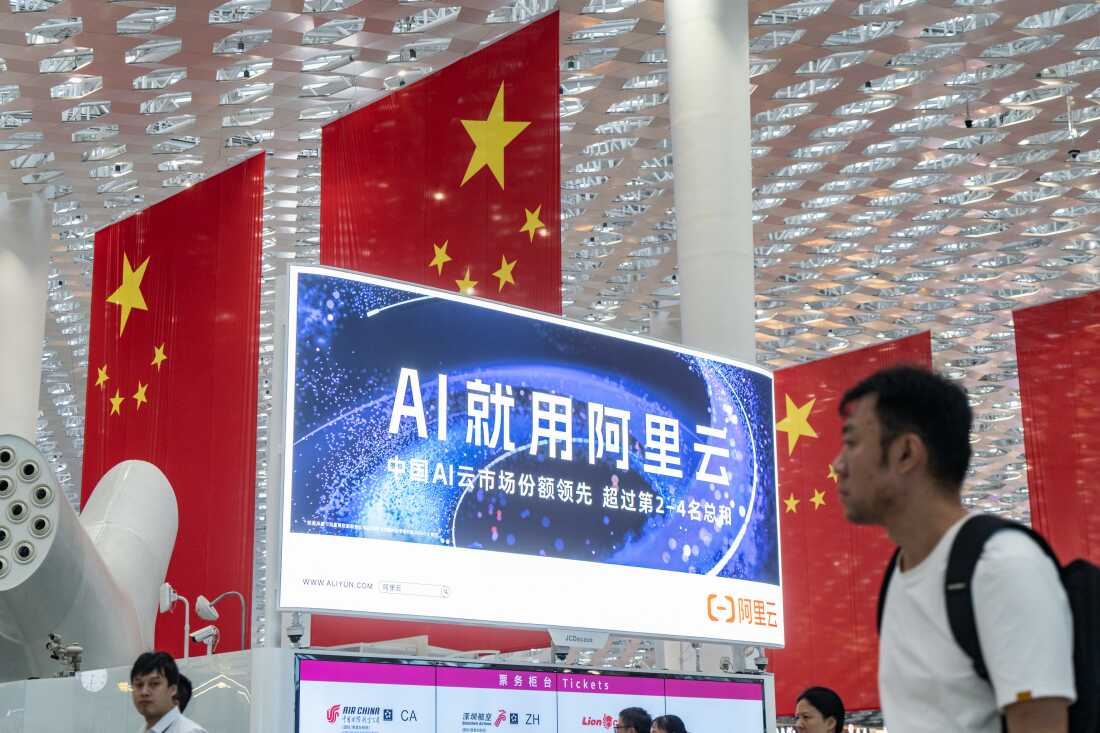
Travelers noticed an Alibaba Cloud ad at Shenzhen Bao’an International Airport in Shenzhen, China, on October 7, 2025. Recently, Alibaba Group Holding Ltd. reported significant growth in its AI-related products.
BEIJING — Economics graduate Elowen Wu has experience in artificial intelligence, yet felt overwhelmed this summer. During her studies, Wu used chatbots for organizing articles, outlining homework, and writing code. In June, she started an internship at an AI startup in Anhui province. Suddenly, her AI skills seemed lacking. “It was a huge shock for me,” she said. “I felt very afraid.”
She shared her anxiety on Xiaohongshu, a social media platform. “Will I be replaced by AI?” she asked in a post. Similar concerns exist in the U.S. but Chinese firms adopt AI on a much larger scale, driven by top leaders.
In recent months, courts and panels in several Chinese cities ruled in favor of workers displaced by AI, marking a win for labor rights. For instance, a worker in Guangzhou trains a humanoid robot to push buttons, with expectations that robots will take over human tasks.
In June, Guangzhou’s court detailed a graphics designer’s case, named only as Wei. He lost his job at a tech company when AI replaced him. The firm, unnamed by the court, paid him 41,000 yuan ($6,000) as severance, citing “major changes in objective circumstances.” The Guangzhou Intermediate People’s Court confirmed this dismissal was illegal and awarded Wei an extra 35,000 yuan ($5,200).
“Employers cannot shift technology risks onto employees,” noted Judge Chen Shiyuan, adding companies should offer other roles or training before ending contracts. Similar judgments occurred in other cities.
“Legal protection is necessary,” Wu stated, though she believes time is needed to refine it. Global law firm Taylor Wessing’s Guang Li said countries observe China’s approach. An arbitration case last year in Beijing received interest from legal experts in Europe.
China’s laws offer strong worker protection. “It’s more protective than Europe or the U.S.,” Li stated. But enforcement is lax. Cornell University’s Eli Friedman said Chinese workers face vulnerability. A tech worker displaced by AI in Hangzhou won his case but, at 35, is considered old for tech roles. “It could feel like a real existential crisis,” noted Friedman.
China’s sluggish economy adds pressure, with employers seeking cost cuts like wages. One in six youths aged 16 to 24 unable to find a job in June underscores this. Wu added, “China’s job market is very competitive.” Competition heightens with AI advances.
As AI rivalry with the U.S. intensifies, outcomes look increasingly challenging. “You can’t aim to lead future industries, then worry about worker replacement,” Friedman explained. Wu remains focused on her master’s degree, staying informed through AI podcasts and videos. “Keep learning,” she advised, emphasizing overcoming fear of the unknown. “Otherwise, you might be left behind.”