
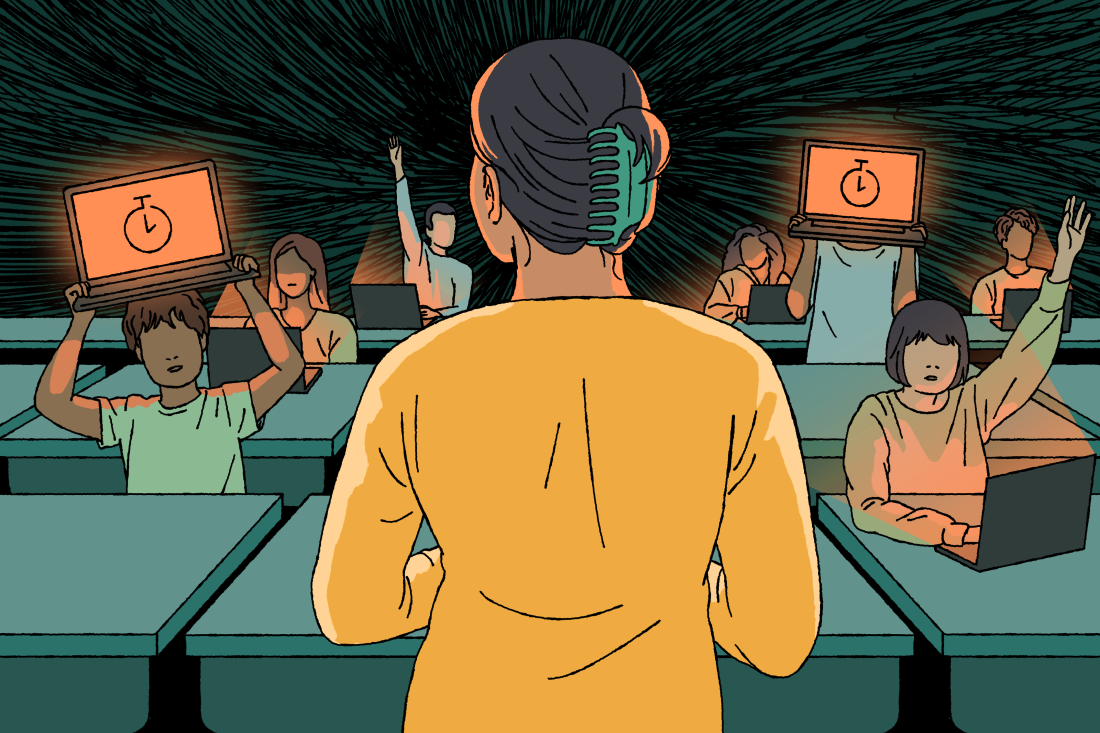
Charlotte Gomez for NPR highlights the challenges educators like Armaghan Khan face with new screen time regulations in the Los Angeles Unified School District (LAUSD). This year, the district has implemented a strict policy to ban screen time for younger students and impose significant limits for older ones.
Changes in Classroom Technology Use
Armaghan Khan, a science teacher with extensive experience in LAUSD, states, “This is going to have a big impact on me.” Khan estimates that about 75% of classroom activities previously involved screens. Technology has been a crucial tool for his students, offering opportunities such as conducting large-scale science experiments using laptops. These virtual tools are especially vital given the limitations of budget and resources in non-screen-based activity.
This shift marks a significant departure for a district that was once a leader in integrating technology into education. Beginning this academic year, the district’s resolution dictates zero screen time for 1st grade and younger. In November, this restriction extends to all elementary students, with middle and high schools adopting similar limits later.
Implementing the New Policy
Pia Sadaqatmal, the new chief academic officer in LAUSD, acknowledges the challenges of implementing these rules in such a large district. “There is no perfect solution on how to roll out to a school district the size of ours,” she says. She views this year as a transitional period and urges patience as the district learns at each implementation stage.
Software will track students’ screen time weekly. However, devices will not be automatically disabled once limits are reached. Instead, data collected throughout the year will guide future adjustments in policy.
Educators’ Perspectives
Kirti Baranwal, a teacher librarian, believes screen time limits are, in principle, beneficial. Reflecting on last year’s cell phone ban, she notes students often exceeded recommended screen time, with reports of 8-10 hours a day.
Baranwal, echoing Khan’s concerns, believes unplugging completely leaves gaps. Many students lack access to extracurricular programs, relying heavily on screens for entertainment and engagement outside school. Teachers like Baranwal ask, “When screens are off, what other activities should we encourage?”
As the new school year begins, the focus is on understanding and adapting to these changes. The district is determined to find effective ways to balance screen time with productive, alternative activities.