
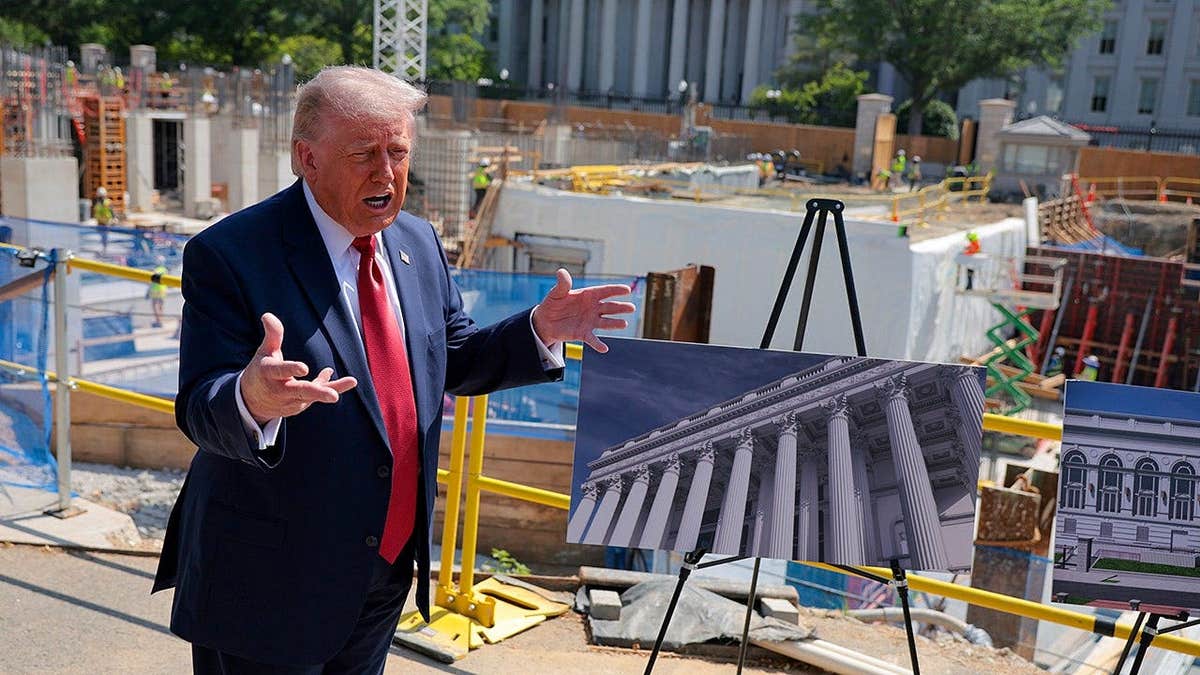
President Donald Trump’s proposed White House ballroom may succeed in the legal arena, according to two legal experts. They suggest that the U.S. Supreme Court could dismiss the case without addressing the constitutional issue at its core.
Trump expressed his intention to take the case to the Supreme Court after the D.C. Circuit supported a lower court’s decision preventing above-ground construction. The appeals court, in a 2-1 ruling, determined that the project needs Congressional approval before proceeding.
The dissenting opinion from Judge Neomi Rao, appointed during Trump’s first term, forms the basis for the appeal. Rao contended that the plaintiffs, the National Trust for Historic Preservation, lack the standing necessary in the dispute. The Trust argued it had standing based on Alison Hoagland’s personal use of the visiting area.
Hoagland, a close resident of the White House, claimed that the ballroom’s design would detract from her enjoyment of the President’s Park. However, Rao disagreed, stating that aesthetic dislike does not outweigh national security concerns.
Former Justice Department attorney Abhishek Kambli echoed this position, suggesting the National Trust faces a challenging task in proving its standing at the Supreme Court. Kambli emphasized that ownership or frequent use of the area could aid their claim, which Hoagland does not sufficiently demonstrate.
The problem of standing hadn’t vanished in other recent cases. In a related ruling, U.S. District Judge Amit Mehta dismissed a suit aiming to halt the America 250 UFC event at the White House, citing lack of significant aesthetic harm.
Hans von Spakovsky from Advancing American Freedom expected Trump’s victory in appealing based on similar grounds. He reiterated that legal precedents require showing tangible harm, which Hoagland’s claim lacks.
If the Supreme Court reviews the case, it could do so without ruling on the ballroom’s legal authority, von Spakovsky stated. He doubted other parties, including Congress, could fulfill the criteria for establishing standing due to partisan tensions.
The National Trust claimed that new constructions on federal land in D.C. need Congressional approval. The Trump administration argued otherwise, asserting that existing laws provide the president authority for such improvements.
Kambli agreed with Rao that terms like “alteration” and “improvement” hold specific real estate connotations. He provided examples of home extensions and open-layout redesigns, explaining that such changes do not classify as new constructions.