
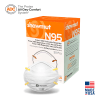
N95 respirators are considered highly protective face masks by the Centers for Disease Control and Prevention (CDC). These masks filter out at least 95% of airborne particles and fit snugly to minimize gaps around the face. The National Institute for Occupational Safety and Health (NIOSH) regulates N95s in the United States, ensuring their availability compared to international alternatives like KN95s and KF94s.
Understanding N95 Masks
Most people equate ‘masks’ and ‘respirators,’ but in medical terms, ‘respirators’ specifically refer to fitted face coverings like N95s with certified filtration. Here is what sets N95 respirators apart from other disposable masks:
- NIOSH Approval: NIOSH-approved N95s ensure they meet stringent testing standards.
- Design and Fit: They have two head straps and an adjustable nose bridge for a secure fit.
- Markings: Appropriate labels indicate NIOSH approval.
- Shapes: Options include cup-shaped, flat fold, and duckbill, each offering comfort based on personal preference.
Popular NIOSH-Approved N95 Models
- 3M Aura: Foldable with a three-panel design. Available in packs of 10 or 20.
- Shawmut: Comes in packs of 20 or 240. Features foam lining to avoid fogging glasses.
- Honeywell: Flat-folding design, available in packs of 20.
- DemeTech: Five-layer structure, pack of 20.
Proper Usage of N95 Masks
Correct use is crucial for effective protection:
- Fit: Ensure a tight seal by covering your nose and mouth.
- Seal Test: Perform an at-home leak test by breathing out to check for air escape and adjust accordingly.
When to Wear a Face Mask
Masks reduce the transmission of viruses such as flu and Covid-19. Consider wearing a mask:
- In crowded spaces: These include grocery stores and public transportation.
- If you’re ill: Wear a mask to avoid spreading illness.
- High-risk scenarios: Ideal for those with pre-existing conditions or during high transmission periods as indicated by CDC trackers.
Frequently Asked Questions
Can N95s be reused? If stored properly in a paper or mesh bag, they can be reused. But replace them if damaged or if a snug fit isn’t achievable.
Are they suitable for children? While generally not tested for children, some smaller models may fit.
Are they reimbursable? Yes, through FSA, HSA, or HRA.
Expert Insights
Dr. David Rempel and Dr. Stella Hines provide guidance on fit and approval, while Dr. Carl Fichtenbaum suggests usage scenarios, and Dr. Sharon Nachman advises on community risk assessments.
For more information on face masks and the latest health tools, visit NBC Selected and follow on social media.