
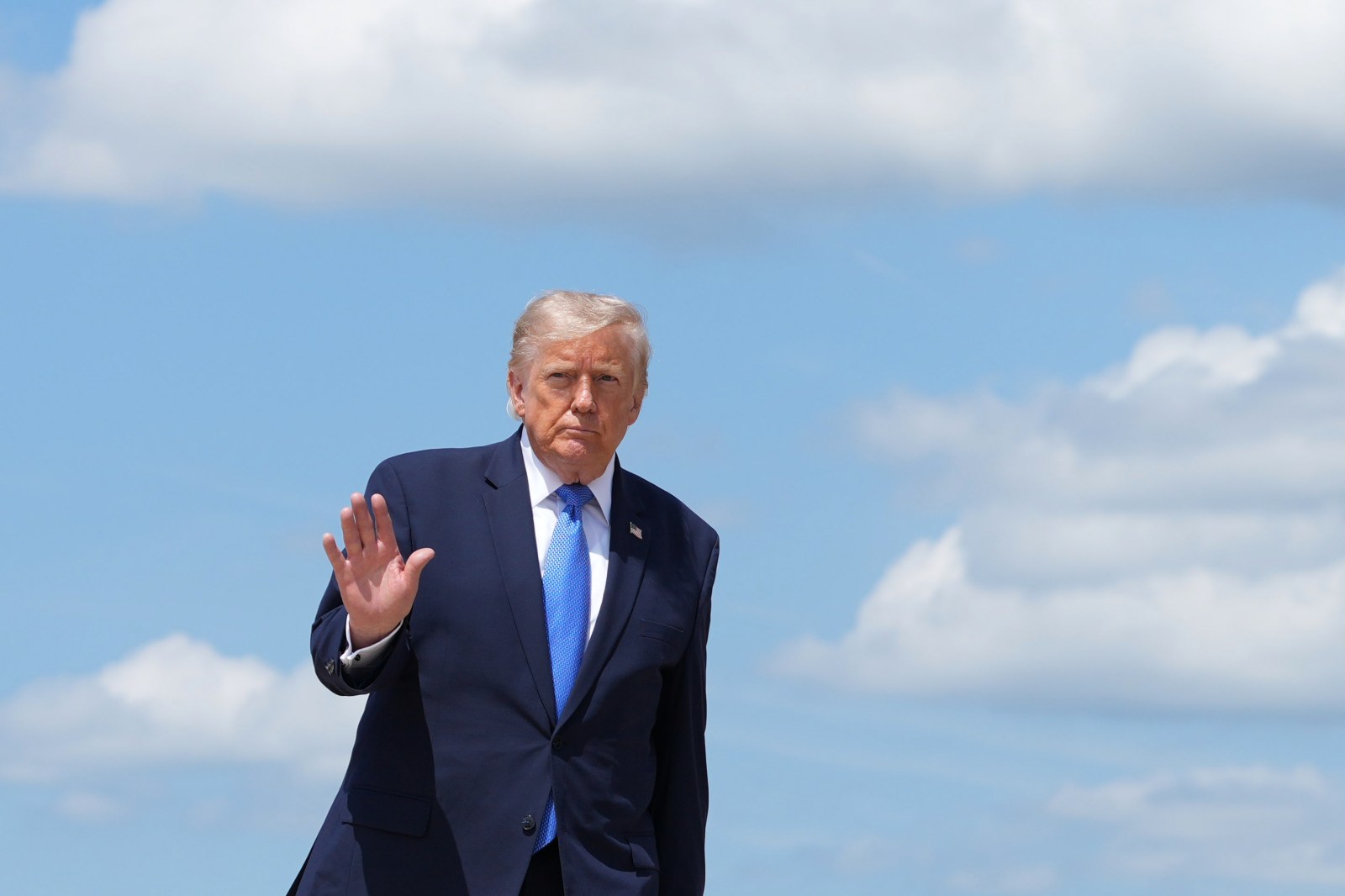
President Donald Trump is on a campaign-style trip across the West Coast, highlighting his economic record. Despite these efforts, public sentiment remains skeptical about the economy under his administration. On Tuesday, Trump departed from Washington, D.C., and arrived in Los Angeles for a two-day tour. His first stop was at a Republican National Committee fundraising event at his golf club in Rancho Palos Verdes, California.
The trip continued with an event scheduled at Red Rock Casino in Las Vegas, Nevada. There, Trump was anticipated to address issues like crime and the economy. The White House presented these visits as an opportunity to emphasize Trump’s accomplishments and draw a contrast with the policies of West Coast Democrats.
White House Assistant Press Secretary Olivia Wales commented that Trump would delineate differences between his agenda and the radical policies of Democratic figures like Gavin Newsom. She criticized Newsom for increasing taxes and protecting criminal elements, according to her statement on platform X.
Despite the administration’s promotion of Trump’s economic track record, voter confidence has waned. According to a July Harris Poll for The Guardian, 95 percent of Americans view the country as being in an affordability crisis. Rising expenses for essential items such as groceries and gas are a driving force behind this sentiment. The view spans across party lines, impacting both Democrats and Republicans, including many core Trump supporters.
“Voters experience the economy not through GDP charts or stock market gains, but at the grocery store, the gas pump, and the kitchen table,” said Matt Klink, a political consultant.
Data from multiple polls illustrate the public’s concerns. A YouGov/Economist poll revealed that only 30 percent of respondents approved of Trump’s economic management, while 65 percent disapproved. This represents a net approval decline from earlier in the year. The dissatisfaction is particularly strong regarding inflation, with a majority indicating disapproval of Trump’s handling of the issue.
Several recent surveys, including those by CNN/SSRS and Fox News, show Trump’s net economic approval ratings in the negative. Similarly, an AP-NORC poll found only 32 percent of participants approved of Trump’s economic oversight. Additionally, 69 percent described the economy as in poor condition, with significant concern over costs such as groceries, housing, and gas.
In the lead-up to the midterm elections, Democrats appear to be gaining traction on economic issues. A Reuters/Ipsos poll reported 37 percent of voters trusting the Democratic Party’s economic approach over 36 percent for the Republicans. This marks the first time the GOP has fallen behind on this issue since 2017.
However, it is not only criticism for Trump. Klink advises Democrats to propose concrete solutions to economic challenges rather than merely pointing fingers, considering the lasting memory of inflation issues during Joe Biden’s presidency. Without a robust plan, the midterms might result in tight races.