
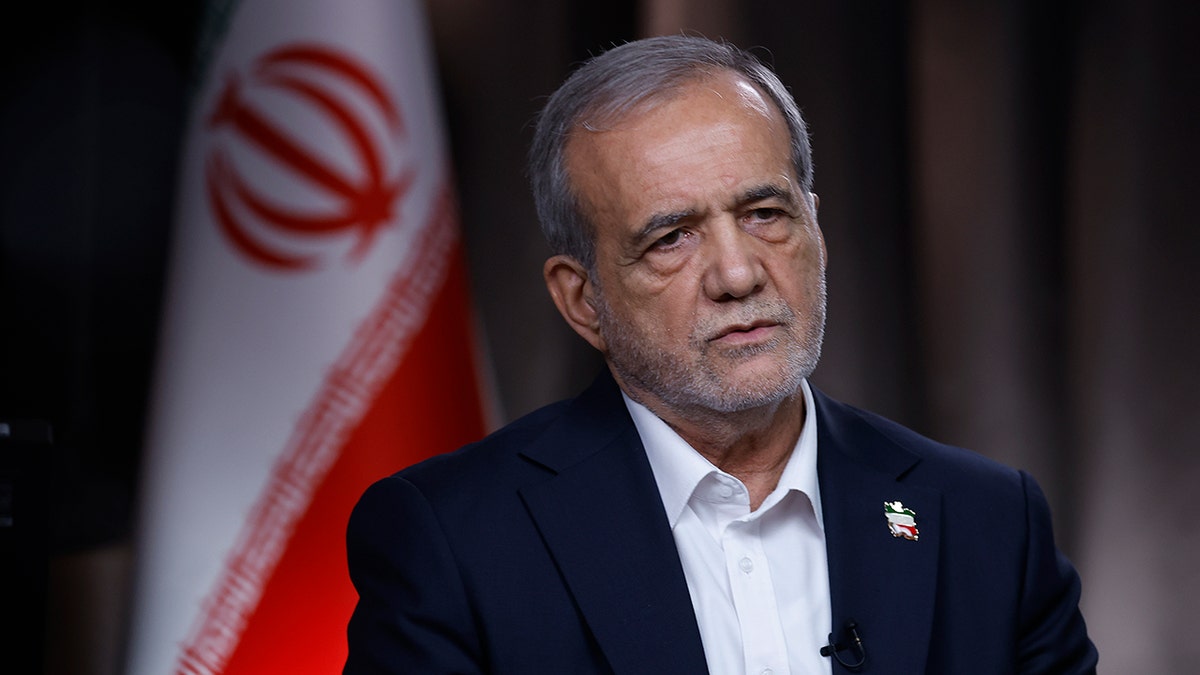
Iran’s political factions are increasingly using the name of Supreme Leader Mojtaba Khamenei to attack rivals and secure their positions, even as his role in governing remains uncertain. This internal conflict became apparent in two reports from Iran International regarding President Masoud Pezeshkian’s interaction with the new leader.
The first report featured senior cleric Mohammad-Bagher Kharrazi, who is related to the Khamenei family by marriage. He claimed that President Pezeshkian had repeatedly threatened resignation and was cautioned that his next attempt would be accepted. Kharrazi quoted Khamenei as saying, “If he resigns one more time, I will approve it.” Pezeshkian’s office strongly denied this, calling the claims “baseless and an outright lie” through his deputy Mehdi Tabatabaei.
Another report from Iran International suggested Pezeshkian met Mojtaba Khamenei only once, in a covert meeting where they couldn’t see each other and Pezeshkian questioned the voice’s authenticity. Pezeshkian’s previous description of a lengthy, cordial meeting contradicts these claims.
Kasra Aarabi, head of IRGC research at United Against Nuclear Iran, noted that Pezeshkian’s situation reflects a larger struggle within what he describes as an “Islamist oligarchic mafia system.” He said that Ali Khamenei, the former supreme leader, acted as a “godfather” arbitrating among Islamist factions. His departure left a gap that Mojtaba Khamenei was appointed to fill, but his absence has left factions uncertain.
Aarabi explained that these factions are competing for power and economic interests rather than ideology. Mojtaba’s name has become a political tool used to legitimize actions and constrain opposing factions. According to Aarabi, “Mojtaba’s name is the glue holding the system together right now.”
Exiled journalist Mehdi Ghadimi described the resignation rumors as a common tactic for reformist administrations aiming to build public sympathy. Similar tactics were used during the terms of former presidents Mohammad Khatami and Hassan Rouhani.
Ghadimi speculated, “Either he is dead, or he is being kept alive in an unstable condition.” Aarabi noted the reports illustrate the power dynamics, with Pezeshkian’s detractors invoking Mojtaba’s authority to undermine him, while supporters counter with accounts of direct meetings.
Mojtaba Khamenei has not appeared in public or released any videos or recordings since assuming his father’s position. Conflicting reports about officials’ interactions with him further complicate the situation.
Aarabi warned that invoking Khamenei’s authority will become progressively harder without visible confirmation of his status. “There’s only so many times you can use someone’s name without any proof of life,” he said. “The longer Mojtaba is absent, the more questions develop over whether he is alive or able. As soon as that doubt increases, infighting will likely rise.”
Efrat (Effie) Lachter, a reporter for Fox News Digital, covers global conflicts and political accountability. Her experience spans over 40 countries, documenting crises and interviewing leaders. She has received multiple awards for excellence in journalism.