
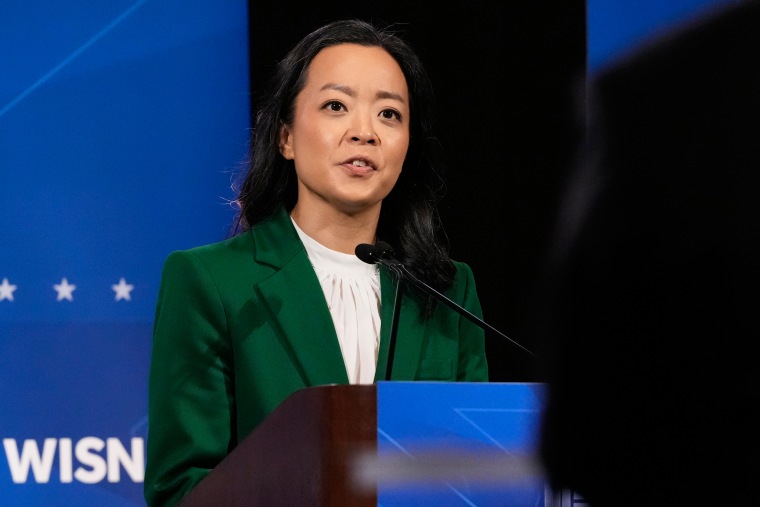
The five Democratic candidates for governor in Wisconsin engaged in a rare debate, marked by a notable absence of personal attacks. This period of the race comes as early voting is already in progress for the August 11 primary. A significant portion of Democratic voters remain undecided, yet the contenders refrained from challenging Francesca Hong, a state representative from Madison who leads in polls. Concerns persist within the party about Hong’s prospects in a general election.
The tension in the otherwise subdued debate emerged between Mandela Barnes and David Crowley. Barnes criticized Crowley, who rejoined the race supported by outgoing Governor Tony Evers’s endorsement. Barnes suggested that Crowley’s resurgence resulted from “special interests in a dark room.” In response, Crowley emphasized his personal struggles and distanced himself from the establishment, asserting his commitment to transforming leadership practices.
The candidates unanimously agreed on several issues, such as reducing property taxes and revising the school voucher program. They also supported increased taxes for individuals earning over $1 million annually. Hong’s association with the Democratic Socialists of America (DSA) evoked minimal controversy, although some Democrats fear her leftist stance might complicate a future contest against Republican Tom Tiffany.
Hong addressed previous campaign criticisms concerning police defunding and prison abolition views. She clarified her positions, distancing herself from aspects of the national DSA’s platform. “I do not support the full platform of the national DSA, and I am not endorsed by DSA national,” she stated.
Hong reaffirmed her dedication to public education funding, taxing wealthier citizens, and promoting universal childcare and affordable housing. Additionally, she expressed optimism that wealthy state residents would ultimately benefit from her policies. “We can improve the quality of life for millionaires,” she mentioned, hopeful for their prosperity in Wisconsin.
A focus of the debate was the recent fatal shooting of a Madison resident by police. This incident spurred protests and calls for accountability. When asked about potential cuts to police funding, Hong, refraining from her earlier stance, replied that she would not approve such measures. “The governor cannot defund police,” she asserted, emphasizing her seriousness about public safety. Similar sentiments were echoed by Barnes and Crowley, both disapproving police budget cuts while advocating for transparency.
Barnes highlighted his statewide electoral experience, contrasting with his rivals, while Crowley pointed to his local government experience as a distinguishing factor. Crowley faced questions regarding past controversial social media posts, but emphasized his leadership strengths and endorsements, including support from Evers and various labor unions.