
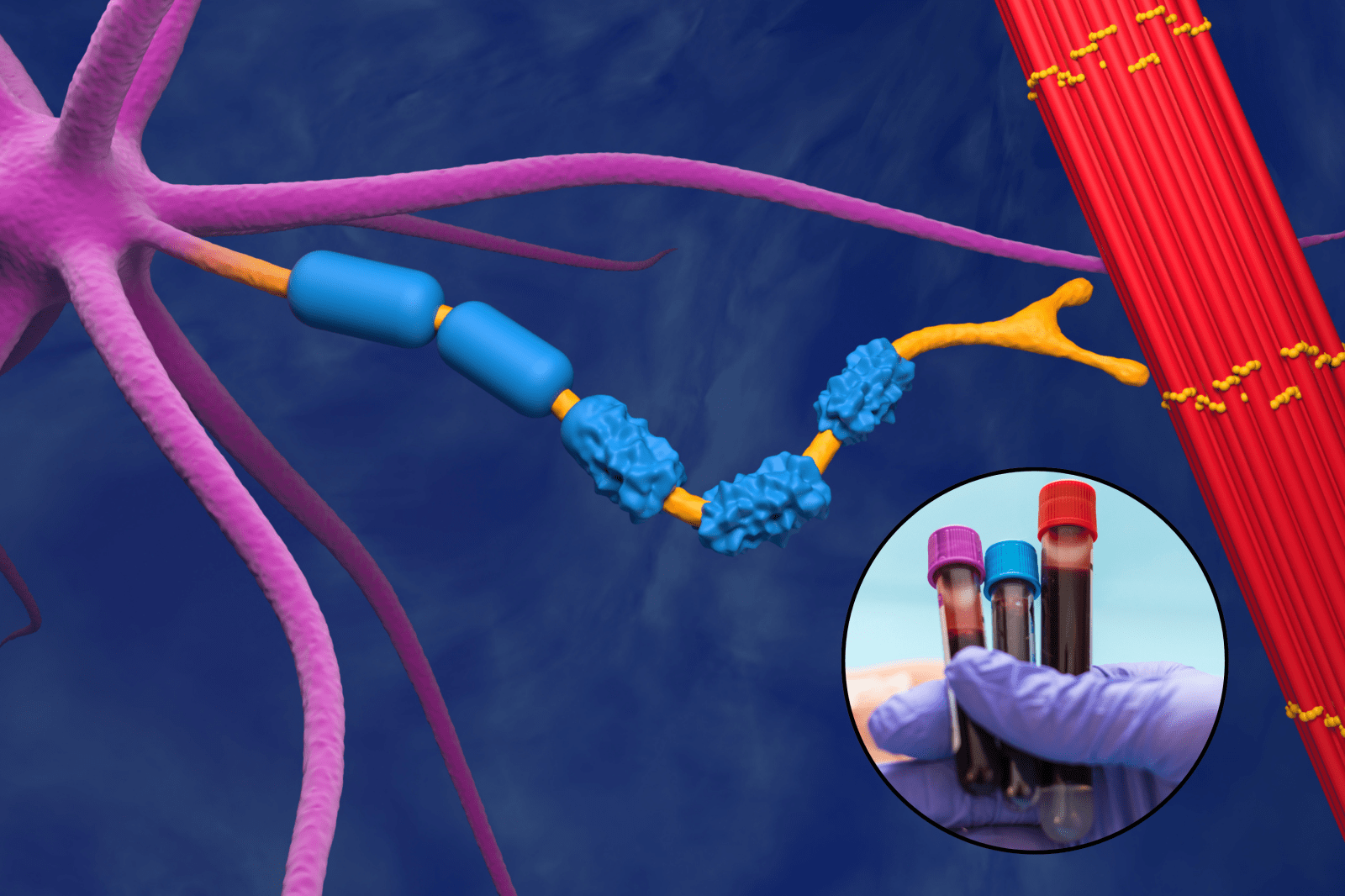
A new discovery in blood proteins could be a significant advancement in the fight against amyotrophic lateral sclerosis (ALS). Researchers have identified proteins that show changes months or even years before symptoms of this neurodegenerative disease surface, potentially allowing for earlier intervention to prevent nerve damage.
About ALS
ALS, known as Lou Gehrig’s disease, affects motor neurons that control movement. The Centers for Disease Control and Prevention states that approximately 5,000 people are diagnosed with ALS annually in the U.S. Symptoms initially present as muscle weakness, twitching, and slurred speech, progressing to impairment in movement, swallowing, and breathing.
Study Findings on Blood Proteins
Findings emerge from the Pre-symptomatic Familial ALS (Pre-fALS) study funded by the National Institutes of Health, which has tracked participants at high genetic risk for ALS for nearly 20 years. Researchers analyzed plasma samples from 137 individuals, including 33 who later developed symptoms of ALS or frontotemporal dementia.
Using proteomic analysis called Olink, more than 5,000 proteins were examined. Ninety-two proteins showed variance before symptom onset. Machine-learning models identified a panel of 19 key proteins, notably neurofilament light chain (NfL), linked to ALS symptoms emerging.
The predictions averaged an error of about 18 months for symptom onset, effective for windows spanning six months to five years prior.
Implications for Early Treatment
Dr. Michael Benatar, a neurology and public health professor at the University of Miami, emphasized the importance of these findings for predicting ALS onset. “The biomarkers provide an improved estimation for symptom onset, which was challenging before,” Benatar stated.
This prediction tool is pivotal in evaluating therapies aiming to prevent or delay disease progression before symptoms appear. Using UK Biobank data confirmed the markers’ applicability beyond inherited ALS cases.
Significance of the Research
Amy Bany Adams, acting director at the NIH’s National Institute of Neurological Disorders and Stroke, highlighted the timely nature of the research alongside emerging preventative gene-targeting treatments requiring reliable biomarkers.
Tofersen, a drug approved for symptomatic ALS, is undergoing trials (ATLAS) to explore if early treatment impacts disease onset.
Benatar acknowledged the crucial contribution of study participants. “Thanks to those who volunteered, we’ve made strides in preventing ALS,” he said.
Reference: Ran, X., Wuu, J., Qin, Z.S. et al. Longitudinal plasma proteomics predict phenoconversion to clinically manifest ALS. Nat Med (2026). DOI: 10.1038/s41591-026-04528-x