
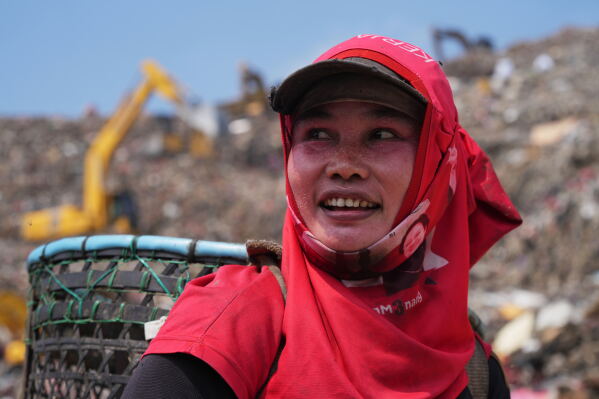
Long before dawn, Nur Wencih and thousands of other waste pickers climb Indonesia’s largest landfill, searching for items to sell. At 35, this widow has worked at Bantargebang, on Jakarta’s eastern edge, for twenty years, following her parents’ footsteps. The landfill has supported her family, including her two teenage daughters who live with relatives elsewhere. Living alone in a rented space near the site, Wencih typically earns about 200,000 rupiah ($12) daily, collecting anything valuable, from plastic bottles to discarded toys. Occasionally, she finds gold jewelry.
“It feels like hitting a jackpot,” Wencih remarked, pausing from the July heat. However, such finds may soon diminish.
Waste Management Reforms
Starting August 1, Indonesia plans to overhaul this landfill, transitioning from open dumping to more controlled systems as part of a national waste management plan. Announced last month, the government will cease open dumping at 343 out of 550 disposal sites nationwide, requiring a shift to sanitary systems that accept only non-recyclable waste.
Residents are now required to separate organic waste and recyclables, a practice not widely taught. Dudi Gardesi Asikin, Jakarta’s Environment Agency head, stated this aims to enhance environmental health, reduce pollution, and curb methane emissions.
Methane significantly impacts global warming, trapping more heat than carbon dioxide. U.N. Secretary-General António Guterres urges governments to minimize methane emissions.
Challenges and Impacts
Bantargebang emits vast methane amounts, making it central to these reforms. Opened in 1989, it was initially designed for sanitary waste treatment. However, post-2016, the landfill reverted to open dumping. Today, only two of the original twelve methane extraction wells work.
As part of the transformation, areas are now covered with tarps, with Asikin estimating that full coverage could cost 200 billion rupiah ($12 million). This change poses challenges for approximately 600,000 waste pickers who rely on landfills for livelihood. Bantargebang alone employs over 4,000 registered waste pickers daily.
“What worries me most is how I will feed my family,” Wencih expressed.
While these reforms might threaten current livelihoods, the government plans to create safer jobs in the recycling and composting sectors. Asikin believes this will provide secure employment for waste pickers.
Economic and Environmental Concerns
Bunin, a nearby neighborhood chief, acknowledges the pollution but also sees economic benefits, like business opportunities, resulting from the landfill’s existence.
Covering 110 hectares, Bantargebang forms a mountain, rising 60 meters high. It receives about 7,500 tons of daily waste. A recent collapse due to heavy rain, which claimed seven lives, highlighted potential risks.
“This situation is extremely urgent,” said Agung Pujo Winarko, site manager. “It risks exceeding its limits.”
Research indicates Bantargebang was the second-largest landfill methane emitter worldwide in 2025. Reducing organic waste might lower emissions, but landfills will need prolonged monitoring.
Changing Waste Habits
Jakarta residents are now urged to separate organic and recyclable waste. New fuel plants are also part of the strategy. Asikin describes this endeavor as transformative, considering prior habits where waste sorting was unheard of.
“All we know is to throw the trash in the bin, not to sort it,” said Central Jakarta resident Rukasih Wanti.
Supported by multiple government bodies, new infrastructures are necessary. Only about one-quarter of Indonesia’s waste is managed formally, with the rest unmanaged. Environmental advocates like David Sutasurya emphasize the need for better systems.
For over a decade, Monica T. Anggriani has pushed for household waste separation, creating a community initiative that processes organic waste through composting and other methods.
“Our generation was never taught to separate waste,” Anggriani stated. “If we don’t start now, nothing will change.”