
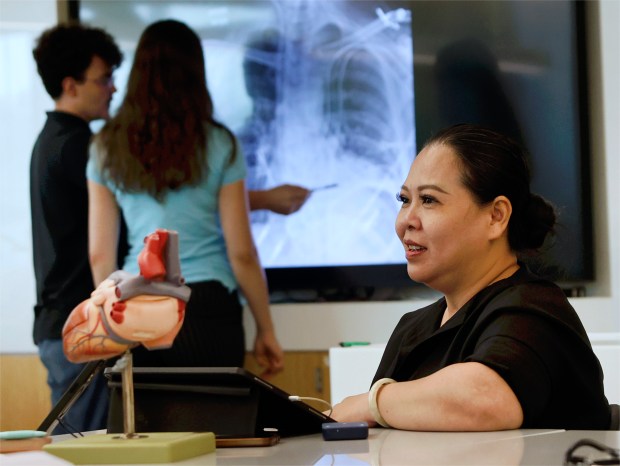
Nguyen Thi My Dieu read case details aloud, making Dr. Ernest Talarico Jr. smile. Dieu, a Vietnamese student attending Talarico’s fourth annual seminar at Purdue Northwest, is adjusting to English medical terms. Her willingness to read aloud shows her progress and growing confidence. This will benefit her as she and her peers visit Purdue’s West Lafayette campus on July 30 to present their research.
Participants in the two-week problem-based learning seminar, led by Dr. Ernest Talarico, assistant professor of practice in Anatomy and Physiology at Purdue Northwest, include students from Tan Tao University in Vietnam and local high schools such as Lake Central and Homewood Flossmoor. They tackled a medical case involving a man with bilateral cardiomyopathy progressing to hydrocephalus. While studying physiology, they also learned patient interaction techniques, addressing questions from the patient and family. This case is particularly relevant to Vietnamese students due to growing heart disease concerns in Vietnam.
The case involved a middle-aged man struggling with tasks like climbing stairs. X-rays revealed bilateral cardiomyopathy, stemming from hemochromatosis, or excess iron in the heart. Students deliberated on transplantation ethics and fielded questions such as, ‘Is my dad going to die?’
The situation worsened with the development of a brain infection, indicating transplant rejection. Students then needed to devise appropriate treatments. They examined EKG and cardiac echo results, gaining knowledge to apply in Vietnam as technology advances.
Talarico noted, “This isn’t about lacking industrialized medicine in Vietnam, but access challenges hinder many.”
He emphasized that students gain more than medical knowledge, they also experience cultural exchange. This interaction helps improve care standards when they return home. Rising heart disease rates in Vietnam are partly due to the influence of Western fast food, Talarico mentioned.
Another seminar participant, Omar Hijaz, a Lake Central graduate starting at Purdue West Lafayette, shared his motivations. Despite aiming for orthopedic sports surgery due to personal experiences, his encounter with limited medical resources while visiting family in Palestine influenced him. Witnessing a single doctor serve an entire village, frequently without a clinic, opened his eyes to disparities. His career choice, focusing on orthopedic injuries, will prepare him to assist underprivileged communities.
Dr. Talarico’s seminar bridges educational gaps while providing cultural insights, fostering cross-border understanding in medical practice.