
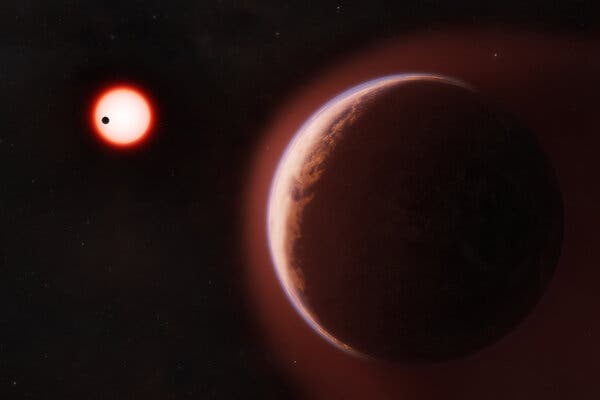
Astronomers have identified a world with key features necessary for life, making significant strides in the search for habitable planets beyond our solar system. The exoplanet, known as LHS 1140b, exhibits the essential traits for hosting life: a rocky surface, an optimal temperature for liquid water, and the presence of an atmosphere.
Collin Cherubim, a newly graduated planetary scientist from Harvard University, remarked, “At this point, we have absolutely no evidence for life on the planet. But we think all of the really important, essential ingredients are there.” This discovery could mark an important step towards finding life beyond Earth.
LHS 1140b, located a few dozen light-years away, orbits its star in the habitable zone, a region where conditions are suitable for liquid water on the planet’s surface. First observed in 2017, the exoplanet is cooler and larger than Earth in both size and mass.
New research indicates that LHS 1140b possesses a helium-rich atmosphere. This finding, published in Science, represents the first clear detection of an atmosphere on a potentially habitable world. It suggests the existence of planets similar to Earth with the potential for life.
“When there’s one, there’s more in exoplanets,” stated Sara Seager, an astrophysicist at M.I.T. who was not involved in the study. “Hopefully this is the start of something new.”
An atmosphere is crucial for a planet’s habitability, as it sustains water, moderates the climate, and shields the surface from cosmic radiation. While atmospheres have been found on larger gas planets, detecting them on rocky worlds has been more challenging due to their smaller size.