
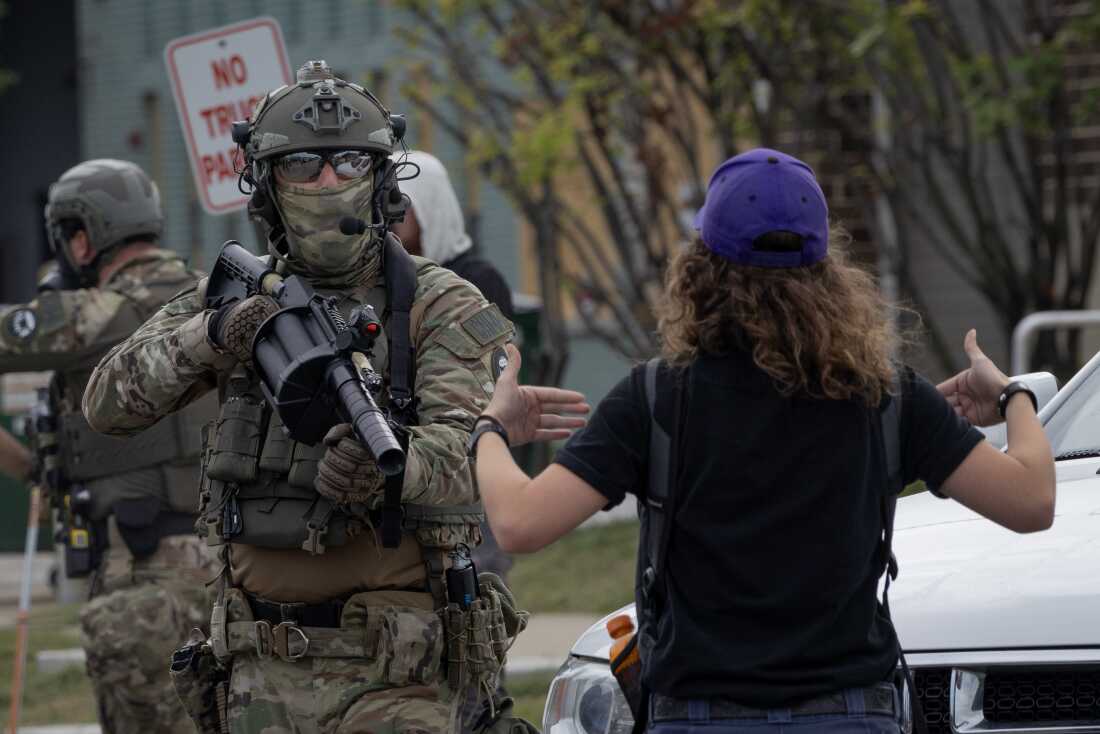
In Broadview, Illinois, federal law enforcement agents faced demonstrators outside an immigration processing center on September 19, 2025. The protests followed a surge in ICE operations in Chicago, part of an initiative dubbed Operation Midway Blitz under the Trump administration to target undocumented immigrants.
The American Civil Liberties Union (ACLU) has released a new report highlighting the extensive use of force by Immigration and Customs Enforcement (ICE) officers. The report details over 1,200 enforcement operations from January 2025 until the end of the previous year, across eight states. These operations occurred post-President Trump’s re-election and indicate growing concerns among immigrant advocates about aggressive deportation strategies.
Nearly one-third of the incidents documented involved force or threats of force. Naureen Shah, the ACLU’s Director of Policy and Government Affairs for immigration, expressed that reliance on force is becoming a standard practice for immigration enforcement agents. The report includes encounters sourced from news articles, press releases, and community group reports, offering a comprehensive view of enforcement activities and locations.
Seth Stoughton, a law professor at the University of South Carolina, criticizes the lack of transparency from governmental bodies, underscoring the need for public accountability in a democratic society.
Patterns of Force in Immigration Enforcement
The report documented varied force deployment methods. Agents reportedly pushed, tackled, or pinned individuals to the ground over 400 times and used weapons like chemical irritants, rubber bullets, and tasers. There were also instances of potentially lethal tactics, such as using knees on necks or chokeholds, which are restricted by many local police agencies.
The ACLU report showed that ICE interactions frequently occurred in everyday settings like bus stops and grocery stores, involving children, U.S. citizens, protesters, bystanders, and journalists. The data provides a snapshot in time but suggests widespread operations beyond those publicly reported.
Experts attribute the increase in violent encounters to expanded federal funding for ICE. Shah warns of more potential killings, noting a culture of pressure-driven arrest quotas and the normalization of force and intimidation tactics.
Changing Enforcement Strategies
ICE has changed its approach to immigration enforcement. Jillian Snider, lecturer and former New York City police officer, notes a shift from targeted operations to more frequent community presence and an increase in car stops by ICE officers, despite limited training.
Two recent killings in Texas and Maine involved ICE officers shooting individuals during car interactions—a method not typical of targeted operations. The deaths occurred without officers wearing body cameras.
The report also recorded numerous traffic-related incidents, including officers ramming vehicles, boxing in cars, and breaking windows, tactics often restricted by police agencies.
Stoughton highlights the potential supervision issues and questions why supervisors fail to rectify recurring problematic behaviors. A recent incident in Florida involved a third person dying after a semi-truck collision while fleeing ICE officers during a traffic stop.
Challenges in Traffic Stops
Traffic stops present complex challenges for officers, requiring consideration of many factors. Marc Brown, from the University of South Carolina’s Excellence in Policing and Public Safety Program, emphasizes gaps in training and policy adaptations for ICE’s evolving mission.
Following recent shootings, ICE will temporarily suspend non-urgent traffic stops. The agency remains silent on specific tactics but plans to continuously evaluate procedures for officer safety.
President Trump, however, advocates for the continuation of ICE traffic stops through a Truth Social post.
Sergio Martínez-Beltrán from NPR contributed to this report.