
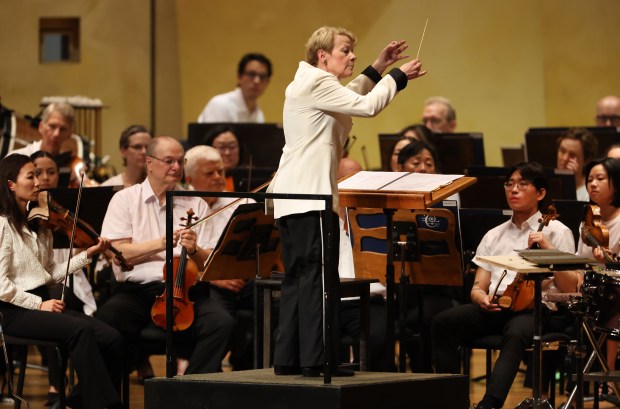
In 2022, Marin Alsop began to see the tangible results of her work at Ravinia. Entering her second summer at the festival, Alsop, known for shattering the glass ceiling as the first woman to lead major orchestras in several countries, initiated ‘Breaking Barriers’. This was a festival-within-a-festival aiming to highlight women in leadership roles, especially in male-dominated fields.
Breaking Barriers initially focused on female conductors, including Alsop herself. The sight of families engaging with the exhibit of 100 women conductors struck a significant chord with her. Now, at the age of 70, Alsop is leaving her position at Ravinia after six years as chief conductor and curator. During her time, she helped guide the Chicago Symphony through pandemic recovery and the transition into the renovated Hunter Pavilion.
Breaking Barriers, which invited women professionals from areas like science, culinary arts, and music composition, became one of her key achievements. The latest iteration, co-curated by composer Laura Karpman, focused on film music. Karpman, a classmate of Alsop’s from Juilliard, was praised by Alsop for her versatility and ability to compose across various genres.
“The thing about Laura is that she’s a chameleon. She can really write any type of music, any style music, and she embraces all genres,” Alsop says.
Every year, Breaking Barriers also serves as a meeting ground for the Taki Alsop Conducting Fellowship. This program mentors and coaches women conductors, establishing a supportive community. Many fellows seize the opportunity for podium time at the festival, keeping the connections strong via WhatsApp.
Jeff Haydon, Ravinia’s president and CEO, emphasized the camaraderie among the fellows, likening it to a sorority. Though Alsop’s Ravinia chapter is closing, both the Taki Alsop summit and Breaking Barriers will persist. Starting next year, the fellowship will move to Prague Summer Nights, aligning with Alsop’s growing presence in Europe. She has assumed roles with orchestras in Poland, London, and an honorary position in Vienna.
Despite her international commitments, Alsop maintains her ties to American music. She held leadership at the Peabody Institute in Baltimore and remains connected as music director laureate. Alsop also serves as principal guest conductor for the Philadelphia Orchestra, collaborating on innovative projects like a refreshed version of ‘Fidelio’ with sociologist Reuben Jonathan Miller.
Her approach at Ravinia was to weave the traditional with modern perspectives, evident in her programs like Beethoven’s Symphony No. 9 paired with West African drumming. This method, contrasting with the Chicago Symphony’s usual programming, has been well received by audiences and orchestra members alike.
Musicians such as clarinetist John Bruce Yeh and bassoonist Miles Maner credit Alsop with rejuvenating the festival and embracing broader orchestral repertoires. Her nearly complete Mahler symphony cycle remains a highlight. Alsop will soon become the first female conductor to record a Mahler cycle, scheduled to release its first volume next spring.
Emphasizing inclusivity in classical music remains central to Alsop’s mission. Recent years have seen a slight shift with more women like Nathalie Stutzmann and Xian Zhang leading major U.S. orchestras, though challenges persist. Alsop notes the common struggles women face across various fields, from music to the culinary arts.
Looking forward at Ravinia, the festival is undergoing changes in leadership and programming. With plans for its 125th anniversary in sight, Ravinia will invite artists-in-residence to curate future events, diversifying its cultural offerings. The president, Jeff Haydon, mentioned the potential for collaborations across disciplines similar to the Ojai Music Festival’s model.
Of note, Alsop’s remaining performances with the Chicago Symphony include several notable concerts such as an all-Beethoven program and a special Mahler’s Sixth Symphony event. Her impact at Ravinia remains influential, and her forward-thinking initiatives will likely continue to guide the festival’s future endeavors.