
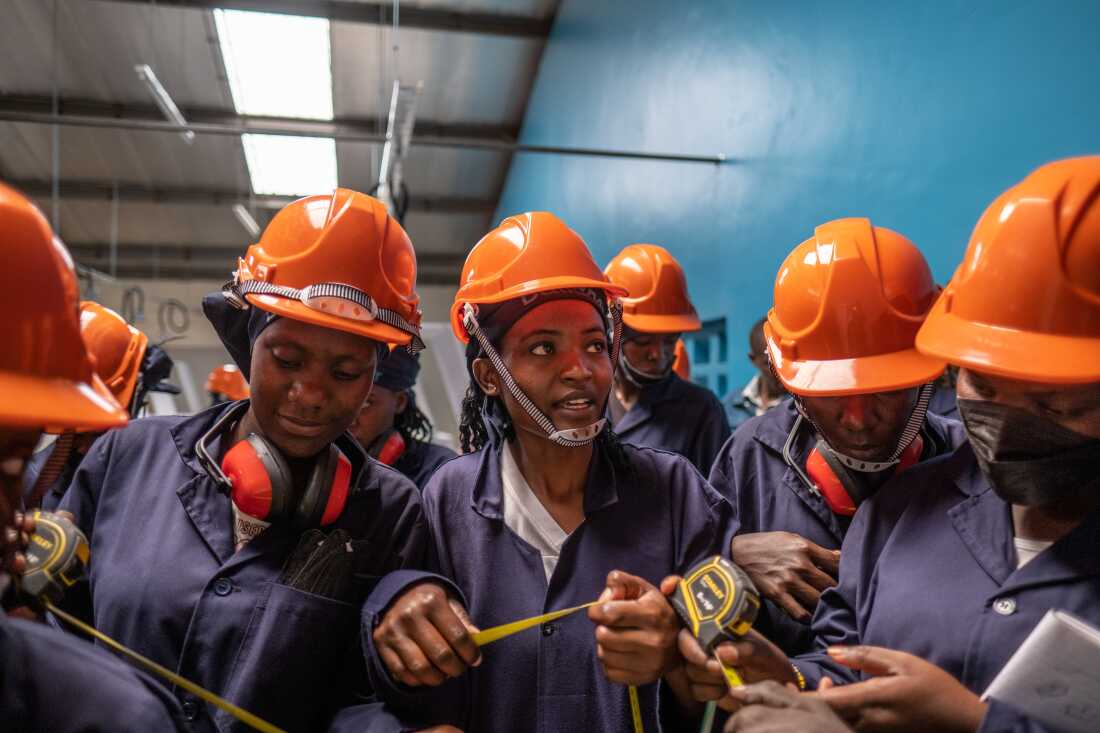
At the Buildher training facility in Nairobi, Kenya, students actively participate in courses like tiling. On the workshop floor of Furniture International, a company on Nairobi’s outskirts, the noise of machinery is constant. Diana Ojiambo, a 24-year-old machine operator, reflects on her experience: “I was shy at first,” she explains while operating a PVC edger. “But now I am more confident speaking up.” Diana, along with three other women, works on cabinetry tasks amidst predominantly male colleagues. Just a year ago, these women were newcomers to the construction industry.
In Kenya, women make up only 3% of accredited construction artisans according to the National Construction Authority. Many women who do work in construction often hold low-paying informal positions, such as carrying water or cleaning sites. Traditional gender roles continue to limit women’s opportunities.
Buildher, a nonprofit in Nairobi, aims to shift this dynamic. It conducts year-long programs in trades including carpentry, tiling, and painting. Since 2019, Buildher has trained over 1,000 women, significantly boosting their earnings. According to a 2024 Dalberg study, 65% of Buildher graduates continued in construction a year after training. Co-founder Tatu Gatere notes, “I wanted women to recognize their potential.” Many graduates, like Ojiambo, inspire others by word of mouth.
“My life was so challenging,” Ojiambo shares, “But now I can support myself and my kids.”
Ojiambo plans to start her own carpentry business in Kibera, the informal settlement where she resides. Despite some male peers doubting women’s capabilities in the field, Ojiambo believes in showing her competence.
Buildher’s curriculum extends beyond trades. New students engage in orientation at Buildher’s training center in Spectrum Business Park. Lessons include a solar installation course, expanding into technical trades. Trainees practice techniques like tiling, guided by trainers like Robert Ndungu. Programs equip women with practical skills that lead to financial stability.
Gatere highlights the broader challenges women face, from childcare to resistance at home about women in construction. Buildher teaches skills but also prepares women emotionally and physically for industry challenges. Onsite facilities like yoga and mindfulness sessions help manage stress.
According to Dalberg’s research on women in construction, programs like Buildher see success beyond increased incomes. Graduates report heightened control over household decisions and community support. Soft skills training is also praised.
Ruth Kiarie, a student in the painting cohort, aims to work in color psychology, linking her interest in colors to her experiences caring for her daughter. Kiarie believes that color choice affects emotions, and she hopes to advise families on these matters.
Buildher works with projects like Tatu City to expand their influence. Tatu City is a large development symbolizing Kenya’s urban shift. Buildher trainees contributed to jobs like finishing at Eneo at Tatu Central, impressing employers with quality and professionalism.
Buildher collaborates with roughly 150 companies, intending to raise women’s sector involvement to 10% by 2030. Achieving this requires structural industry changes, like addressing workplace harassment and ensuring equitable conditions for women.
Gatere envisions a future where women naturally hold construction leadership roles. She dreams of environments where women’s safety and dignity are standard, freeing them to pursue ambitious business goals.
Margaret Klamaitha, who completed Buildher’s tiling program, now works on a contract at Tatu City. Klamaitha sees this job as a step towards future roles, like quality control, and eventually hopes to run her own construction business.
“Mindset is key,” Klamaitha says. “Start something as a woman and don’t let negativity hold you back.”