
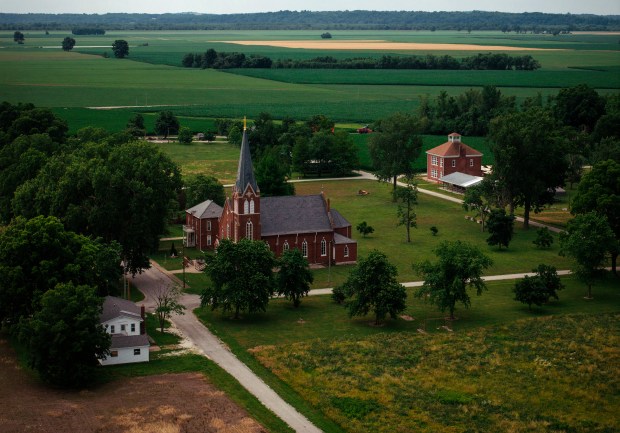
The congregation of Immaculate Conception Church gathers each Saturday before Mass, at a church marked by both serenity and great loss. Once thriving, Kaskaskia, the first capital of Illinois, is now largely claimed by nature due to repeated flooding. Located on an island west of the Mississippi, it’s the sole part of Illinois that remains on this side of the river, showcasing the river’s influence and unpredictability.
An aerial view taken on May 23, 2026, highlights Immaculate Conception Church, founded by Jacques Marquette in 1675. (Source: E. Jason Wambsgans/Chicago Tribune)
Kaskaskia holds rich history, from a Liberty Bell gifted by King Louis XV, to stories predating America’s founding. Despite its decimation, the church survives, enduring floods and the river’s whimsy. It stands as a symbol of perseverance much like the island. Once a hub during westward expansion and an American Revolution battleground, it held prominence as Illinois’ capital until 1818. However, devastating floods in 1844 and 1881 altered the river’s path, transforming Kaskaskia into an island.
Stanley Hurst, among the few residents, recounts the 1993 floods where Mississippi’s waters breached the levee, leading him to relocate to nearby St. Mary. Each weekend, Hurst returns to Kaskaskia, maintaining his connection to the church amidst a dwindling congregation.
Mary Ellen Brown, alongside Emily Lyons, exemplifies dedication to preserving the island’s legacy. Both grew up here, committed to sharing its history. Their work is akin to stewardship, knowing the inevitable passage of time threatens memories and stories.
Lyons oversees Immaculate Conception, founded by Marquette, highlighting its historical significance. She reflects on the parish’s history from its 1730s altar to a Jesuit chalice. The 1993 flood submerged relics, compelling locals like Hurst to initiate restoration efforts. The church remains as one of two tangible pieces of ‘old town’ history, alongside the bell.
Approximately 22 residents remain in Kaskaskia, although visiting suggests fewer. The island exudes solitude outside Saturday afternoons, when families like Warren and Kathy Gendron visit the cemetery to honor their heritage. Although once vibrant, the community now sits largely dormant with remnants of old Kaskaskia buried by time and the river.
A scenic gravel road on May 24, 2026, meanders through Kaskaskia and its surrounding farms. (Source: E. Jason Wambsgans/Chicago Tribune)
Despite isolation, Immaculate Conception draws its congregation weekly, exemplified by a recent Mass led by the Rev. Vincent Obi. Attendance peaks on Easter or Christmas, underscoring the church’s importance. The commitment of locals like Brown, Lyons, and Hurst keeps the church alive, embodying resilience against alternating current struggles. They fought to restore significant elements, such as statues, and appealed to the Diocese for support.
Brown mentions Bishop Wilton Gregory’s role in safeguarding the church’s future post-flood. Obituaries and images capture the ’93 flood’s aftermath, showcasing the depth of faith in overcoming adversity. Brown echoes this sentiment through a scrapbook detailing local history and recovery efforts.
Kaskaskia’s past reveals resilience amidst nature’s unpredictable challenges. The historic site, symbolic of perseverance, remains vulnerable to the Mississippi’s whims. It persists, driven by rich land farming and unwavering faith at the church. Despite concerns among the congregation, its legacy underscores three centuries’ worth of cultural and historical significance.
The Rev. Vincent Obi greets parishioners after a Saturday Mass on May 23, 2026. (Source: E. Jason Wambsgans/Chicago Tribune)
Mary Ellen Brown contemplates criticism, emphasizing Kaskaskia’s long-standing significance despite visible decay. As Mass concludes, parishioners disperse, leaving behind quiet reflective of both solitude and enduring history.