
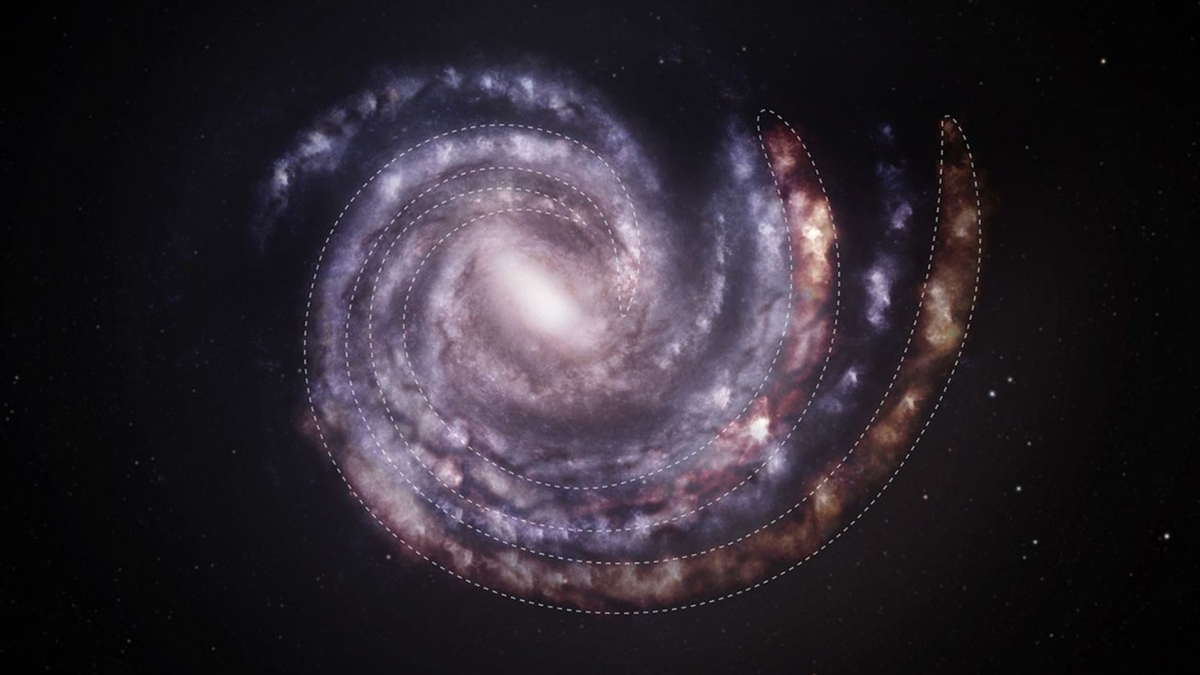
A group of astronomers has revealed that the Milky Way galaxy’s spiral arms may extend farther into space than previously believed. This discovery comes from precise measurements of dust clouds using data from two high-altitude telescopes: NASA’s Chandra, the most potent X-ray telescope ever created, and the European Space Agency’s XMM-Newton.
The scientists utilized rare, potent gamma-ray bursts originating from distant galaxies. When X-rays from these bursts passed through the Milky Way, some light scattered off dust clouds, forming rings that were measured with exceptional precision. This method provided a direct way, based solely on geometric principles, to accurately assess the distances of the Milky Way’s spiral arms. Beatrice Vaia, an Italian PhD student who led the study, noted that traditional methods depend on assumptions about the galaxy’s rotation, leading to increased uncertainty in its outer regions.
A key finding from the research estimated that the dust cloud in the farthest arm of the Milky Way spans about 3,500 light-years in width. Although astronomers have known about the galaxy’s spiral arms for at least a century, mapping them has proven challenging, as Earth is located within one of them.
The recent advancement in utilizing gamma-ray bursts offers a significant potential to change our understanding of our place in the universe. The revision of distance estimates, though minor, is crucial for a comprehensive understanding of the Milky Way. Such changes might necessitate adjustments in the galaxy’s mass estimates and how wide its arms extend, as pointed out by Ilaria Fornasiero, a co-author of the study.
The downside of this method is the rarity of suitable gamma-ray bursts. Researchers have identified only a few in the last 25 years that facilitated the measurement of the spiral arms. Despite the challenges, co-author Andrea Tiengo mentioned that the team will continue searching for more.