
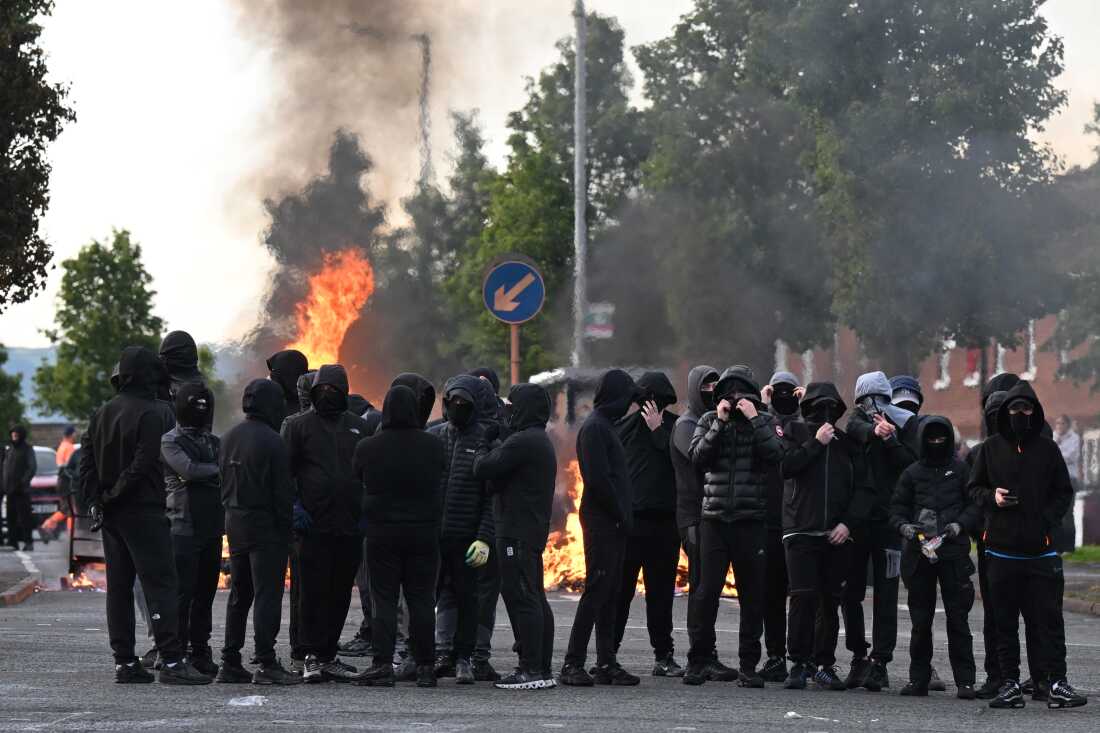
Youths gathered in front of a burning barricade on Duncairn Gardens on June 9 in Belfast, Northern Ireland. The violent events that erupted in Belfast earlier this month have drawn significant attention from experts who study violent extremism. The disorder was triggered by the stabbing of Stephen Ogilvie, a 44-year-old man, by a 30-year-old Sudanese asylum seeker in the UK. Although Ogilvie survived the stabbing, he suffered serious injuries, leading to charges of attempted murder against the alleged assailant.
Following the stabbing, protests erupted in Belfast. Masked, anti-immigrant mobs set vehicles and homes ablaze in predominantly ethnic minority neighborhoods. This has raised questions about the rapid organization of participants and the possible involvement of neo-Nazi youth groups known as “active clubs.” Michael Colborne, a journalist and researcher for Bellingcat, noted the similarities between the violence in Belfast and the activities of these groups.
Active clubs, which focus on combat sports, have been emerging across Western Europe and the U.S. These clubs foster transnational connections through digital platforms and conferences. Colborne emphasized that their interest in combat sports is explicitly about preparing for political violence, rather than fitness or self-defense.
Speculation has arisen about whether active clubs played a role in orchestrating the attacks. Reports suggest that social media activity on active club accounts both before and after the unrest may indicate involvement. However, some observers remain skeptical, highlighting that Northern Ireland’s political history and social infrastructure contribute to the situation.
Sid Venkataramakrishnan from the Institute for Strategic Dialogue described the UK as a “tinderbox,” asserting that violence could have occurred irrespective of active club involvement. He mentioned the Ulster Youth Club’s Telegram account, which shared a post encouraging white men to make non-white people “terrified.” Hours before the riots, the account advised protesters not to bring smartphones and to camouflage tattoos, raising suspicions about orchestration.
Despite the speculation, it remains unclear whether individuals affiliated with active clubs were among those in the streets on June 9. Expert opinions suggest that sectarian violence history in Northern Ireland plays a significant role. Venkataramakrishnan pointed to the Loyalist groups, mainly Protestant and working-class formations, previously involved in violent attacks.
Anti-immigrant violence appears as a recurring theme in Northern Ireland during recent years. In August 2024, Belfast and other UK cities witnessed disorder following the killing of three young girls in Southampton by a UK-born individual of Rwandan immigrant parents. In 2025, allegations involving ethnic Roma residents in Ballymena led to extensive violence, driving many from the town.
Far-right figures such as billionaire Elon Musk have seized on crimes against white UK residents to push messages of ethnic expulsions. These cases have been used by anti-immigrant networks to organize street actions. Venkataramakrishnan noted the UK far-right’s ability to mobilize rapidly for action, both online and offline.
The interplay between former paramilitary groups and anti-immigrant networks is another area of interest. Some individuals involved in the anti-immigration network identify as former Loyalist prisoners. A representative from The Accountability Project, a volunteer group monitoring anti-immigrant networks, suggested that the age of paramilitary veterans is greater than those involved in recent Belfast violence.
The representative speculated that younger participants may communicate via closed apps like Signal, WhatsApp, or Telegram. She raised questions about possible connections between paramilitary groups and the anti-immigrant networks visible on social media. Northern Ireland’s police investigation into recent unrest is being watched closely for answers to these questions.