
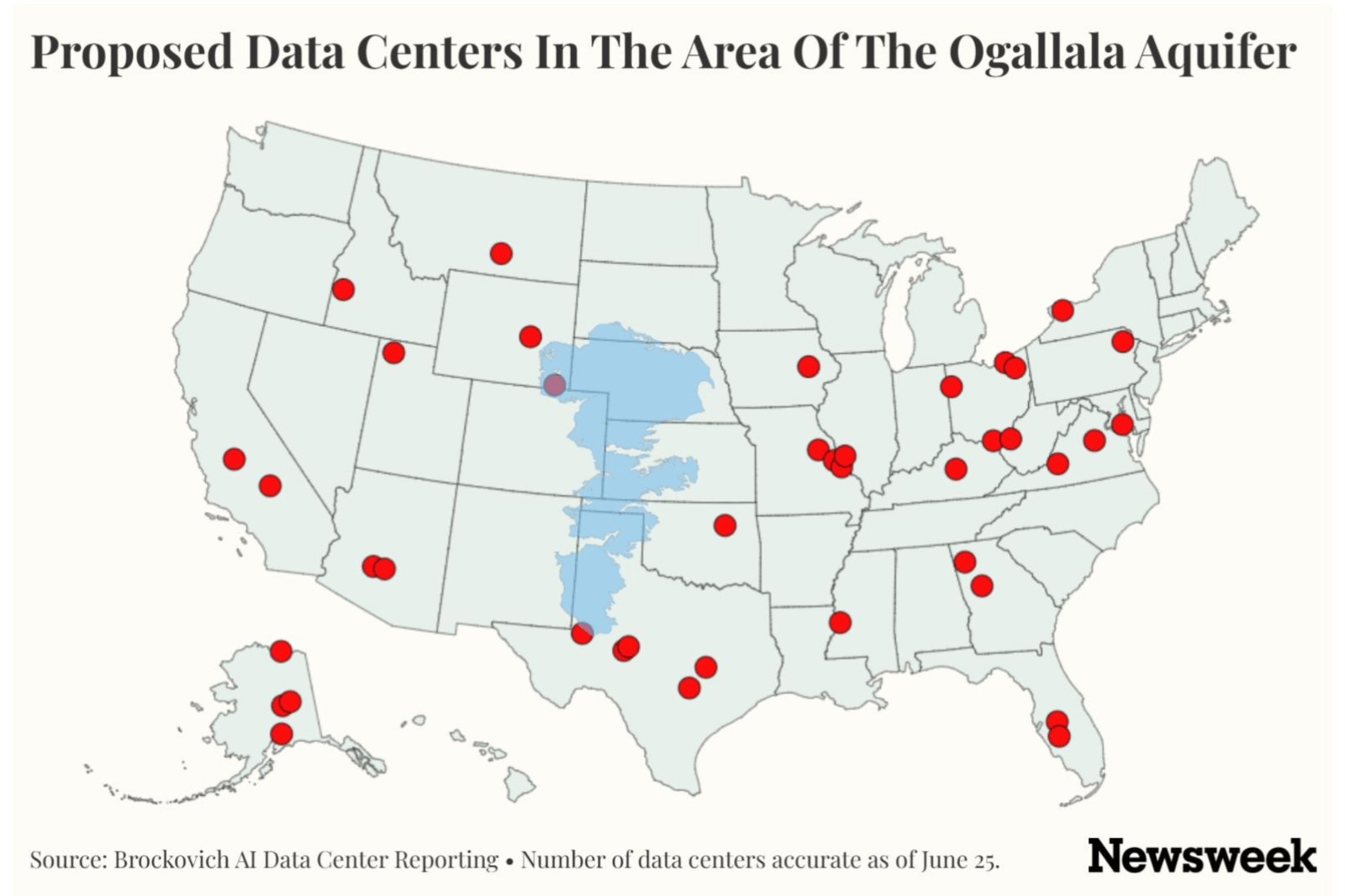
The rapid growth of AI data centers is raising new environmental concerns across the Great Plains. A key question is whether the Ogallala Aquifer can support both a burgeoning digital economy and the agricultural communities that depend on it. The latest mapping from Brockovich AI Data Center Reporting reveals that many new AI facilities are either situated on top of or near the Ogallala Aquifer, a critical water source for U.S. agriculture.
Concerns in Texas and Wyoming
As more AI developments emerge, local governments in states like Texas and Wyoming must balance the economic advantages of AI investments against fears of water scarcity. For instance, Charlie Hamilton, Chief Site Development Officer of the Fermi Project Matador in Amarillo, Texas, emphasized water conservation in a testimony before the Texas House Natural Resources Committee on June 24, 2026.
Regulatory and Public Reactions
In Tom Green County, Texas, commissioners recently rejected a 12-month moratorium on data center development despite significant public opposition. Previously, they had unanimously called for stricter regulation of data centers’ water use at the state level. While not all data centers directly use water from the aquifer, the development concentration in the area is drawing increased attention from various stakeholders.
Notable Projects Above the Aquifer
Among projects attracting scrutiny, Texas and Wyoming host several large AI-focused campuses located near the aquifer.
- Texas Critical Data Centers: Sited on 438 acres near Odessa, Texas, with construction to begin later in 2026.
- Microsoft Cheyenne Expansion: Located in Cheyenne, Wyoming, the project involves purchasing 3,200 acres for significant infrastructure improvements.
- Prometheus Hyperscale Casper: A proposed 1.5 GW liquid-cooled AI data center near Casper, Wyoming, targeting 2028 for operation.
- Skybox and Beacon Data Center Dove Creek: Proposed AI campuses in San Angelo, Texas, both awaiting preliminary study results.
Environmental Impact of Data Centers
Existing data centers already above the aquifer consist of the following projects:
- Crusoe Project Jade: Located in Laramie County, Wyoming, this 1.8 GW center was approved in January 2026 with completion expected by 2027.
- Related Digital Cheyenne: Construction began in October 2025, focusing on efficient air-cooled systems for minimal water use.
- Fermi Project Matador: An 11 GW campus in Amarillo, Texas, with water conservation efforts highlighted in recent legislative testimony.
- Aligned Project Caprock: A 313-acre campus in Abernathy, Texas, expected to begin service in early 2027.
Water Consumption by Data Centers
Cooling technologies used in data centers have significant environmental implications. Evaporative cooling, used by many facilities, results in high water evaporation rates. Alternatives such as air cooling, dry cooling, and closed-loop systems offer possible water-saving solutions but may require more energy or incur higher initial costs.
Beacon Dove Creek, Microsoft’s Cheyenne expansion, and Prometheus’ Casper campus have not disclosed their cooling configurations, making their water use impact unclear. Sudeep Pasricha, an engineering professor, highlights that water loss is a critical concern, with recharge rates far below withdrawal rates.
Ogallala Aquifer’s Importance
Spanning eight states, the Ogallala Aquifer is vital for U.S. agriculture. It supports 30% of U.S. groundwater irrigation, but decades of excessive use have caused significant depletion. Recharge rates are extremely slow, meaning lost water takes centuries to replenish.
Developers’ Interest in the Great Plains
AI developers are attracted to the Great Plains due to inexpensive land, available power, and favorable regulatory environments. However, cooling technologies at modern AI facilities substantially affect water use. Large campuses can consume water equivalent to small towns, contributing to substantial national water consumption levels.
The debate over data centers’ environmental footprint centers on cooling technology choices. Facilities relying on evaporative cooling lose most of their water through evaporation. However, air cooling and dry cooling could reduce the water footprint.
Broader Water Use Concerns
Data centers also impact water indirectly through the electricity generation process, which can be water-intensive. Therefore, it is crucial to evaluate both on-site and off-site water use impacts.
AI’s Rising Water Demands
With increasing AI workloads, infrastructure demand is soaring. A study by Shaolei Ren from the University of California, Riverside, suggests that AI queries can have significant water footprints. The cumulative impact from AI infrastructure can lead to meaningful water consumption increases across multiple campuses.
Community Concerns and Future Questions
In Texas and Wyoming, communities are pushing for clear answers regarding the impact of water use by AI projects. Concerns focus on consumption levels, water sources, and the risks of water supply tightening. Projects near San Angelo face scrutiny from officials tasked with balancing economic benefits and resource sustainability.
Potential future outcomes could include loss of irrigation capability and shifts in U.S. agriculture. Immediate effects like declining well levels and rising costs are anticipated. According to Pasricha, placing data centers in water-stressed areas is a high-risk decision.
The ongoing debate emphasizes technologies used, development locations, and the community balance between economic growth and resource security. The decisions by developers and policymakers will shape the impact on the Ogallala Aquifer and U.S. agriculture.